
The Last Word: On Slopaganda
Our wonderful postnormal times have given us a string of new words. There is, of course, ‘post-truth’, a product of the now defunct philosophy – or is it theology – of postmodernism. Then, we had ‘brainrot’, produced by sick online content perpetually ingested; ‘vaxx’, short for vaccine (injected); ‘rizz’, internet charm and charisma; and ‘goblin mode’, unapologetic, stupid, and lazy behaviour. These were all Oxford Words of the Year. But there are also numerous other words that OUP missed. Such as ‘delulu’, believing things that are patently false; ‘lewk’, meaning a particular fashion or style; ‘glazing’, excessive praising, normally associated with AI chatbots, but applies equally to a prose produced by code; and ‘snackable’, internet content that you can read or play in small amounts or for a short time, reflecting our ever-shrinking attention spans. Old established words are also given new meaning. So bias does not mean what you think it means. Now it means excessive devotion to a brand, influencer, or a pop group. It is used largely by enthusiasts of K-Pop, the South Korean music genre. Moreover, we have combination terms such as ‘broligarchy’, a merger of ‘bro’ and ‘oligarchy’, coined by the brilliant investigative journalist Carole Cadwalladr, formerly of the Observer. Recently, I learned two new self-explanatory phrases: ‘Epstein class’ and ‘Epstein adjacent’.
So, we come to slopaganda, the latest term to emerge from the world of the world wide web. The emergence of AI enables all sorts of people to quickly produce short texts, images, and videos to present their points of view. Most of them are pretty awful, normally spam or trash, designed to misinform and generate clickbait, and monetise ‘content’. To put it in technical language, it is ‘slop’ – the 2025 Word of the Year. When slop moves to the political arena, where it is intended to promote whoopla and indoctrination, generative AI slop is amalgamated with propaganda and it becomes slopaganda. According to Michał Klincewicz, Mark Alfano, Amir Ebrahimi Fard, three experts on digital sciences, slopaganda is set to take over the world in the next few years. News Corp, the Rupert Murdoch company that owns The Wall Street Journal, The New York Post, The Times (UK), The Sun (UK), Australian mastheads such as The Australian, and Herald Sun, Fox News and Talk TV, produce an immeasurable amount of slopaganda. Just one outlet, News Corp Australia, produces 3,000 ‘local’ generative AI stories each week.
So, it is hardly surprising that the war on Iran has generated a tsunami of AI-generated litter, saturating every feed. Slopaganda does not need a great deal of resources to produce it. You can produce fake news videos and stories at great speed, spread it all over the world, reach down to individual levels, and do it all simultaneously on dozens of accounts. Gemini, Claude, et al do it for you; every military manoeuvre can be turned into a synthetic film, every bomb can be rendered into spectacle, all within hours of the actual event. Fakes can be made quickly; truth requires a very long time to unearth.
Klincewicz, Alfano, and Fard argue that AI-generated slop is uniquely toxic because it is so quickly and cheaply produced and because it ‘introduces mass personalisation, creating tailored messages and narratives’ in an instant. But it need not be toxic. It obviously depends on who is producing it and what is being communicated. And, I would argue, you do not even need AI to generate slop.
The leader of the free world provides good examples of slopaganda. During one particular morning he posted a doctored image of his good self meeting European leaders in the White House, including UK prime minister Keir Starmer, Italian prime minister Giorgia Meloni, and European president Ursula von der Leyen. There is a map in the background that highlights US, Canada, and Greenland in the colours of the American flag. A few minutes later, another image in which he is planting a flag on ‘Greenland, est 2026’. Then a message to annihilate an entire civilisation, an AI-generated image of Trump as Jesus Christ. And on it goes!
You can also write slopaganda, which then ends up on various social media platforms as clickbait. Major Western newspapers are constantly spewing it out. There is a great story in the British weekly Jewish Chronicle, written by Michael Gove, the former Conservative chancellor of the exchequer. The headline ‘The IDF should be nominated for the Peace Prize’ went viral, causing so much laughter that the internet nearly choked. Another story in the Daily Telegraph, by Charles Moore, the right-wing journalist (also known as Baron Moore of Etchingham), carried the headline ‘Netanyahu is the Greatest War Leader of Our Age’. As someone on X said, it is ‘AI Certified Bullshit’ (I think they were using the term as it is used in analytical philosophy: so insane that even the lunatic uttering it does not believe it).
Now, the folks endlessly regurgitating this rubbish may or may not believe it but they certainly know what they are doing. They want you to believe it and they will continue spouting this until you are exhausted and overwhelmed and no longer in a position to tell what is real from what is slopaganda. The idea is to paralyse you with bullshit so you become a complete postmodern dipshit, reduced to an opinionless slop. You lose the very desire to look at evidence, delineate facts from fakes, or spare more than a fraction of a second giving what is put before you an iota of critical thought or concern. Scroll on Christian solider!
Enter, into this high-velocity social media extravaganza, stage left, a new phenomenon. It is not aimed at monetisation, but at increasing your dopamine levels, hitting your pleasure sensitive mental spots. It seeks something deeper than your attention. You don’t have to believe it but it does seek to enhance your ability to think and reason. And it is relevant, exceptionally cleverly made, with a coherent narrative, and high production values. And it drops at least once, if not twice a day, as soon as the news breaks.
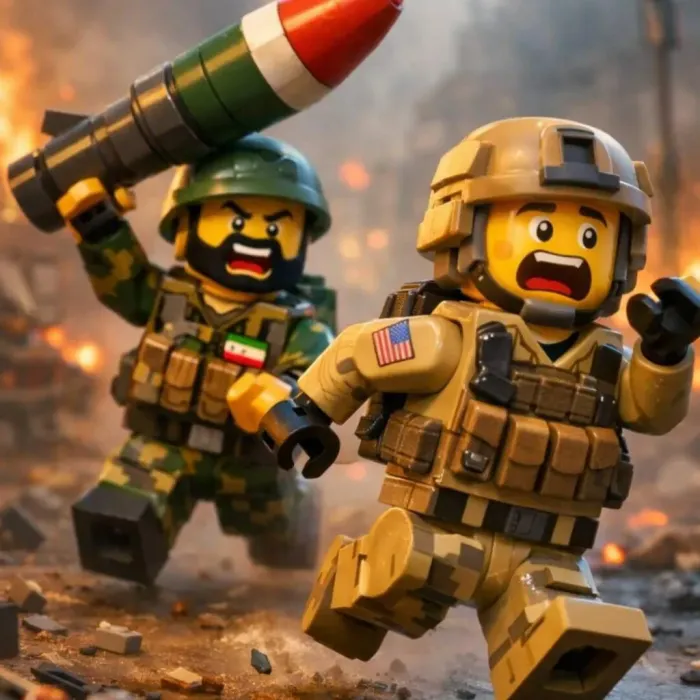
They began to appear in large numbers with the beginning of the US-Israeli war against Iran, although some first emerged in June 2025. Anime and Lego-style animations, generated quickly but with smooth production quality, with quite accurate narrative – certainly more honest and correct than the Israeli narrative stenographers of Western state media. Consider the production values of the Chinese state broadcaster, CCTV, animations. They are modelled on epic Chinese mythological movies. The Iranians are anthropomorphised cats fighting desperately to survive, with Trump as a powerful eagle-headed grandmaster dominating a desert. ‘As a righteous leader of the world’, Trump announces, I will cleanse the house. ‘Bold eagle you call yourself righteous, yet you lay murderous hands on innocent children’, replies the cat leader. It is all very surreal, deeply entrenched in Chinese mythology and martial arts, yet not too far from the truth. The message is simple and straightforward: the US is a reckless bully constantly attacking and exploiting weaker countries.
A number of these animations show the failed US operation to extract uranium from Iran. One starts with a couple getting married and then bombed and goes on to show a little girl who accompanied her father to shoot down a helicopter. It ends with: ‘This is Iran! Welcome to the graveyard of Hawks!’. Another, called ‘The Lie’ from Kutub Productions, about the so-called ceasefire between Iran, US, and Israel, begins with the words: ‘The empire has fallen’.
We cut to:
Soldiers: Leave the payload, the op is blown, move! Missile lock, break right, break right!
[Missile hits jet]
[Jet goes down]
Soldiers: Men down, operation failed, pull out!
[All run into choppers]
Iranian boy: We will find the Americans.
Soldiers: We gotta save them. I’m not dying for Israel. Get me out, now!
[Israeli soldiers shooting]
[Iranian boy holds up a pair of American flag underwear]
Trump: Over the past several hours, the United States Military pulled off one of the most daring rescue operations in history.
Interviewer in the crowd: Americans are wondering you lost 340 million dollars to save one man. Is that a victory?
Trump: You are a fake reporter and those Americans are foolish.
Candace Owen: Trump is willing to sacrifice every American life for Greater Israel. He betrayed America. Best 100 million Miriam Adelson ever spent.
Mexican president: The real mission was the uranium and they failed.
Soviet reporter: Trump sent hundreds of special operations troops into
Iran to seize the uranium from Natanz. They failed, lost roughly 500 million dollars and multiple troop casualties.
Israeli reporter: Trump has been doing a great job defending Israel. Cool name – Epic Fury. I ask Trump and Israel to bomb Lebanon to oblivion.
[Lebanon hospital gets bombed]
Syrian Boy: Free Palestine!
Trump: I will destroy a whole civilisation tonight. Mark my words. It will happen.
Pakistani Prime Minister: Pakistan is the mediator. An immediate ceasefire is now in effect.
Netanyahu: I will not accept peace. This is not over. Starting with Lebanon.
Its mocking, spoken with a Japanese accent, but a reasonable bulletpoint depiction of what actually happened. Okay the boy with American flag underwear is bit naff.
The best products of the animation warfare come from Explosive Media, PersiaBoi Studios, and Midnight Curiosities, available across multiple platforms. Aimed at Gen Z and upwards in the West, they are all over social media and no doubt help persuade many to rethink their position by providing a different perspective on the stories related to the war. I have some friends who even use them to catch up on daily news, rather than go to more conventional source, such as Sky News or CNN.
These animations are impressively crafted, with emphasis on narrative coherence and serious attention to the smallest details. Some are purely pedagogic such as the one on eleventh-century philosopher, physician, and polymath, Ibn Sina, and one comparing the civilisational history of Iran and the US, starting at 3200 BC! But most are commentaries on the news from an Iranian perspective. Often accompanied by rap, they tell the story of ‘breaking news’ with relish and panache, turning the news item into a song – such as ‘Uranium Heist in the Dead Of Night’.
I like ‘Black Flag Rise’ and ‘Regime Change’. The first came out after the murder of young girls at a Minab school in Iran. It begins with:
Yeah, they killed our girls
Blood still on the ground
Now the black flags rise
And ends with:
They, they, they took our daughters
Tried to break our pride
Now vengeance is coming…
‘Regime Change’ begins ‘Yeah, you want a regime change?’ and goes on to mock Trump. ‘You couldn’t do it in Iran, so you did it at home’; ‘Failed in Tehran, now you’re doing it alone’; ‘Army chief gone, generals out the door’.
For me, these videos provide a far more accurate description of the day-to-day narrative than say Fox News and GB News. Many mainstream news outlets appear to use the same phrases over and over again: ‘the sharing of bias and false news has become all too common amongst social media’; ‘this is extremely dangerous to our democracy’; and ‘Iran is the fulcrum of antisemitic behaviour’. As the Netanyahu-appointed head of the Israeli government press office, Eli Hazan, has declared, ‘the truth no longer matters, the facts don’t matter’. The only thing that counts is ‘flooding the zone with fake news’. The American zone is totally submerged. The situation throughout the rest of the West is not much better.
Over in the UK, at the BBC, the slopaganda is a bit more nuanced and with a stiffer upper lip.
As animation wars became more and more popular, the BBC decided to cover the Iranian videos. A feature appeared on its website, written by Matt Shea and Laurie Kalus, hosts of its Top Comment podcast. The headline declared: ‘we spoke to the man making viral Lego-style AI videos for Iran. Experts say it’s powerful propaganda’. They admit that the videos are ‘vivid and fast paced’, but the instantly ‘recognisable Lego aesthetic feature dying children, fighter jets, and US President Donald Trump’. One wonders, given what’s going in the world, what else could they feature? A BBC presenter shutting down a Palestinian guest? BBC’s consistent refusal to recognise a genocide when it sees one? Anyway, they are upset that in one video ‘Donald Trump falls through a whirlwind of “Epstein file” documents as rap lyrics tell us “the secrets are leaking, the pressure is rising”’. The BBC also claims that the ‘videos are also littered with factual inaccuracies’. Only, if you can’t recognise the truth, I would say; and the BBC has difficulty in that department, as Ziauddin Sardar pointed out in CM56: Journalism. ‘The clips are garish and not subtle at all’, which suggests that BBC News – since most of their news reports consist of endless shots of white men walking and talking – has no notion of quality or appreciation of aesthetics. But, the BBC admits, ‘that hasn’t put a dent in how vigorously people are sharing and commenting on them’. And that is the main problem.
When the Iranian programme ‘Tell Us Iran’, interviewed the same person from Explosive Media, he pointed out that the BBC presenters tried to ‘shame us for defending our country’.
Later, a correction was posted under the story: ‘Correction 12 April 2026: This story originally said Husayn ibn Ali was a Shia warrior. This reference has been removed to reflect that he is not categorised as Shia or Sunni in modern terms’. The BBC report had the intended affect: the Lego videos were banned by X.
In this digital age, it is the tech bros and the platform owners who decide what you look at and ingest, who is and is not a liar, and who has all the power and control. The states above all states. We were so preoccupied with looking for the deep-state we allowed a subversion of all states to take place in our own backyard by the college-drop out pirates of Silicon Valley.
The rather frigid Economist also played its part in this endeavour. It was forced to admit that Iranian videos ‘show fluency in their enemy’s culture’ and are out-trolling the Trump administration. It went on to suggest that Iran ‘is not known for its sense of humour’ and that it’s a ‘joyless theocracy’ and ‘a murderous dictatorship’. Clearly, Iranians know more about the West than the West seems to know about Iranian culture and civilisation. When Iran’s ambassador to Pakistan, Reza Amiri Moghadam, referenced Pride and Prejudice, most of the Western newscasters did not get it. ‘A truth universally acknowledged that a single country in possession of a large civilisation, will not negotiate under threat and force’, tweeted Moghadam on X. One presenter on Sky got it, but even after explaining, her screen colleague did not have a clue about the Jane Austen reference. Compared to the banality of the Economist, Iranian humour is sophisticated, laced with poetry, full of historical metaphors and similes.
One only has to look at the Lego videos to see its current manifestation. The videos also reference Kafka, Harold Pinter, René Magritte, and Robert Louis Stevenson – which no doubt goes over the head of most average mainstream journalists. But whether you understand the coded references or not, the young Iranian digital masters have created a universal message that the whole world can grasp. As a CNN report says, ‘whether satire or propaganda, these videos speak to a moment in social media and geopolitics’. They also speak to a deep universal humanity and recognise the common bonds between cultures and societies. While distancing themselves from the horror and pain of imposed circumstances, they emphasise the sacred nature of self-determination, genuine freedom, including freedom of belief. And they do all this with wisdom and biting, but intensely human, humour.
All of this reminds me of a hadith, which we find in Ibn Majjah, and other places. The Prophet once said: ‘There will come to the people years of treachery, when the liar will be regarded as honest, and the honest man will be regarded as a liar; the traitor will be regarded as faithful, and the faithful man will be regarded as a traitor; and the Ruwaibidah will decide matters.’
Those gathered around him were a bit confused, they had not heard the word Ruwaibidah before. So, they asked: ‘Who are the Ruwaibidah?’ The Prophet replied: ‘vile and base men who control the affairs of the people.’
This is much more than slopaganda. This is strategic information for the age of Ruwaibidah!
References
The paper by Michał Klincewicz, Mark Alfano, Amir Ebrahimi Fard, ‘Slopaganda’ appears in Filosofiska Notiser, Årgång 12, Nr. 1, 2025, 135–162. Ziauddin Sardar’s ‘This is the BBC’ appears in Critical Muslim 56: Journalism, Hurst, London, 2026, pp3-26
The ‘Lego’ movies are widely available despite attempts to block them. A good selection can be seen on the Manufacturing Dissent site: https://mandissent.com/p/more-iranian-lego-animationsdestroying?r=3g0g8&utm_medium=ios&triedRedirect=true Both ‘Regime Change’ and ‘Black Flag Rise’ are here. The Anime style video can be viewed at https://x.com/irmilitarymedia/status/2040890268006699156?s=58 and https://x.com/ryanrozbiani/status/2042027367544070210?s=58
A collection of news report on American media uttering exactly the same words can be viewed at: https://x.com/ivan_8848/status/2044722937849168145?s=58
The CNN report can be accessed at: https://x.com/cnnfrancepr/status/2046984265527693387?s=58
For the Economist article, see ‘In the AI propaganda war, Iran is winning’, Economist 17 April 2026