
INTRODUCTION: Manifest This
‘Tis the season for ‘manifesting’!
Manifest that perfect beach bod before spring gives way to summer. Manifest that serene workplace environment, complete with a homeostatic work-life balance. Manifest the picturesque holiday getaway you’ve always been dreaming of. Manifest the ideal you – mind, body, and soul! It all sounds nice and well, but borders on the absurd promises made by men’s hair regrowth products and avant garde perfume adverts. Manifest the career for you! That’s rich, especially when the concept of a career hardly exists in our late-stage capitalist malaise. Manifest that other half, the compatible partner with the right sign and emotional intelligence who has been waiting so long to meet you. All genders and fetishes available, free will sold separately, some assembly required, for best results keep in a well-ventilated area. This is most certainly the sentiment for those plugged into the contemporary digital zeitgeist. Though I suspect for us all as a species, with the world as it is, manifesting is the way to be.

Am I being a bit unfair? A bit too melodramatic for the trend of the day that will certainly pass as quickly as it arose? Indeed, I’d rather our youths and peers be ‘manifesting’ than say partaking in drunken shenanigans, the destruction of public property (unless of course they are destroying symbols of systemic oppression and hate), or the global illicit drug and human-trafficking markets. And it certainly has not ruffled the feathers of conservatives or woke bemoaners. But the word/concept has become a colloquial vocabulary associated with Gen Z. All generational vocabulary should be confronted with suspicion. Yet what is most troubling is how it all sounds a bit too familiar, like an old way of speaking that has created a great deal of today’s problems. For instance, we don’t hear ‘Manifest peace in Palestine’ or ‘Manifest an end to child hunger and suffering’, even ‘Manifest that perfect balance with nature’. And that’s because manifesting is a clever old trap.
As it is used by the young and the hip or by the ever-present and omnipublic influencer, manifesting is the ultimate cerebral fitness challenge. Step one, you begin with a vision or a dream. Step two, you let all your thoughts encourage the idea. Step three, you throw in a bunch of positivity and affirmations. There is no agreed upon metric for this, but one can never have too much of a ‘good thing’, as they say. Step four is effectively a giant question mark. The same question mark that burns through our minds as we read of what must have been in the heads of the US military officers commissioned in the 1970s and 1980s to telekinetically stop the hearts of goats by simply staring at them, while out of their minds on a cocktail of LSD and psilocybin. Step five, the final step, actualisation. It is important to note that most who have added manifesting to their common parlance and daily ritual always use the active tense. One is often manifesting. One has rarely manifested. Most uncommon would be to find a manifester who has manifested. Remember that. Most of the general public find themselves at the moment manifesting their new ‘era’. As if any of their lives are worthy of being divided into historical epochs.
My late friend, the Welsh anthropologist and television producer, Merryl Wyn Davies would have abhorred the idea. I can hear her scoffing now. Glorified ‘navel gazing’ she’d have called it. Magical thinking, bullocks – in agreement with many psychologists who have spoken on the phenomenon of manifesting. ‘Ask them manifesters to manifest the idea of other people beyond their pretty little heads’, she’d say. This must be one of those American ideas. The way she’d say ‘American’ was always loaded with reproachment. I always greatly appreciated that she always spoke of Americans as ‘them’ and me as myself, an individual often excluded from that vile entity conveniently never too far from everything that’s wrong with it all. It brings me back to a one of the many conversations I had with Merryl back in pre-Covid Malaysia.
We used to call it ‘holding court’ when Merryl would entertain guests with deep conversation and coffee in the ‘spacious and luxurious’ room she occupied, just off Jalan Gasing in Petaling Jaya. She would be seated behind her desk. Her desk would hold a machine (her laptop used for writing and research), a pile of scrap paper-mark stuffed books, and an ashtray that was not just an ashtray, but also a cultural object of some significance. Three delivered cups of coffee – always black and strong – would also find a place on the messy desk, two for Merryl and one for her guest. The conversation would begin with the lighting of a fresh Dunhill cigarette. A stream of smoke would ascend to join the atmospheric cloud that perpetually swirled about the upper portion of the high-ceilinged room. The background soundtrack of the room was composed of an air-conditioning unit running in fan mode, the occasional scurrying from within the walls of one jungle animal or another, birdsong from the open window, and Fox News or the BBC (depending on which time zone was alive at that hour), on the television that was always on in the back of the room. Occasionally, the conversation would be interrupted with Merryl criticising the dire state of how female presenters appeared upon the screen these days. HD certainly is not doing anyone any favours. I don’t recall the beginning of this particular conversation, but somehow it floated to the topic of a very peculiar kind of manifesting. ‘Manifest Destiny’ said Merryl, ‘what a lovely little nightmare the Americans have cooked up for us!’
Merryl spoke of manifest destiny as ‘another one of those American buzzwords’ and even recited a few others, often plucked from patriotic, propaganda anthems. She repeated a few more, emphasising their hypocrisy and ultimate irony with regard to real history. Merryl was right. It was a monster and I hadn’t thought about it in quite some time, but it always seemed to linger. And while a textbook definition came to mind, I began to think about what those two words actually meant. Americans, my young self included, are taught about manifest destiny incorrectly. The first wrong step is that it is introduced to the American student as a subject of history. The second fell step was to teach the concept as a vocabulary word. A vocabulary word with a peculiar and set definition. I can picture the pop quiz, a faded photocopy, with the instruction: Fill in the definition of the following words… And there it would stand surrounded by hungry white space – Manifest Destiny. The student would win his or her marks with a simple response – ‘westward expansion’. The A student would note ‘God’s will for American westward expansion’.
‘Into the West!’ Merryl would utter evoking the spirit of classic Hollywood westerns, many of which she treasured. ‘And with God’s blessing,’ I’d add. ‘Well, if God said so!’ Merryl would add cracking into a giggle. ‘And west and west and west they went!’ Merryl would prod. ‘That would eventually lead you right back to the place you started, wouldn’t it?’ I asked taking from what she laid out. ‘Progress on a globe has a funny way of doing that!’ But upon further thought, the phrase seems a bit poetic for cowboys and simple one-street town folk to have come up with. And that’s because there is more to it than what we are taught in school.
The phrase first entered the American lexicon in 1845. It was a simple throwaway line. The American journalist John L O’Sullivan wrote a column titled ‘Annexation’ for the Democratic Review. In the article, he opined that the US should annex the Republic of Texas. The article was essentially an anti-Whig rant, rubbing in the party’s loss to, famed massacrer of natives, Andrew Jackson’s Democratic party in the 1844 election. The article was doomed to be lost to the sands of time. Of course, the Whigs opposed the annexation, but so too did members of the up-and-coming Republican party, notably future US presidents Abraham Lincoln and Ulysses S Grant.
O’Sullivan is a very confusing character and his ideals hard to square. He was not necessarily pro slavery, but certainly a staunch segregationist. He fought against the use of capital punishment, but only for civilised, white people. He is responsible for publishing Ralph Waldo Emerson, Walt Whitman, Nathanial Hawthorne, and Henry David Thoreau, but was also suspected to have been pushing Confederate propaganda in the capital under their payroll. As the American Civil War was revving up, he was sent to be an ambassador to Portugal, I suspect to feed his ego and calm the homefront discourse. He himself didn’t hail ‘Annexation’ as any great work and would probably be disappointed for having it be one of his legacies. He would have likely also been utterly heartbroken that everyone only ever remembers two words from the article.
In ‘Annexation’, O’Sullivan made two arguments. First, that US annexation was what Texans wanted. This was debatable then and remains debatable today. Second, it was what God wanted. Never mind how we got to the conclusion that God wanted something to occur, or even that almighty God would possess such a human quality as to want anything at all. O’Sullivan’s immortal sentence states that it is American’s ‘manifest destiny to overspread and to possess the whole of the continent which Providence has given us’. Manifest here refers to that which is obvious. Destiny, in the curious way early American Protestants used it, is certainty. Providence is a common transatlantic word somewhat bastardised by early American Christians to mean God’s (of the ‘civilised’, Christian variety) will. So, God gave the US a continent and it would be the same as looking a gift horse in the mouth to not fill it with good old American values and institutions. Up front, this is a very curious interpretation of the American Revolutionary War. Apparently, bluffing the British and staying alive long enough for them to lose interest, while tricking the French into bankrupting themselves for your accord, equates to God gifting you one or two (but who is counting?) of the seven continents of the planet. The divine right of kings is child’s play when compared to nineteenth-century American delusionism. So, the annexation in question was obvious and certain, one way or another. The point was that O’Sullivan was not evoking a John Gast painting of an angelic, white woman (of Lady Liberty coding) floating above settlers, pointing in the direction of west. More banally, he just said eventually it will happen, so why not make it so now and get on with it. At its origin it was a grotesque normalisation. But then he goes on to note that it is not only obvious, but justified, because all of what God wants is justified, by definition.
Yet, once laid out, it seems odd that any American of the time would really have a need to oppose the argument. But the opposition did not come from the two arguments made. The reason the annexation was opposed was because one of those ‘American values and institutions’ was slavery. Yet, the Democrats had the day, and Congress passed a joint resolution admitting Texas into the union as a slave state. This immediately triggered the Mexican-American War which General Ulysses S Grant would later note as ‘one of the most unjust ever waged by a stronger against a weaker nation’. In its nearly 250 years history, the US has had a lot of contenders for this title. Many thanks to that little phrase ‘manifest destiny’.
It is in fact rather devious how the hardcore Jacksonian Democrats distilled an entire op-ed into two words. A keen look at these words reveals something more sinister. Manifest comes from the combination of manus, referring to the hand, and festus, struck or grasped. Suddenly, western empiricism and the notion of private property enter the game. Something is made obvious when you can see and touch it with your hands. Seeing, and feeling, is believing. What is real is what is tangible. Also, let us not forget the age old classical liberal idea of if you have put your hand to something, it then becomes something you can claim as your property (from spouses to a farmstead). If you dig a hole, you own the land removed, the land around the land you removed, and add a couple of hundred years of international relations thinking and a few miles of sea around that land as well (and any precious minerals below it)! Destiny comes from the Latin destinare, to make firm or to establish. Interestingly, in French destinée is a feminine noun. Through French it becomes certain or permanent. The feminine is indeed strong and eternal. Where O’Sullivan meant manifest destiny as an obvious thing that will happen, we now have a concept where if we put our hands into crafting something to be beheld, we can permanently claim it as ours, regardless of how it was acquired, or happened upon, in the first place. Even though the article was mostly forgotten, the Democrats were already using the phrase they clipped from an old periodical to make claims for the eventual annexation of the Oregan Territory only a year later, noting that the Brits could not civilise the place as Americans could.
‘You see the Americans are far superior at civilising than the Brits,’ I put forward with a smile. ‘Oh I don’t know,’ Merryl would retort, ‘History shows that they were both pretty bad at the enterprise.’ After a sip of coffee, a thought. ‘Basically, all of American foreign policy has been shaped by manifest destiny.’ After lighting a new cigarette, Merryl would continue, ‘well no wonder the Department of State (recently renamed the Department of War) cannot cope with those 3 Cs of postnormal times. Complexity, chaos, contradictions, can’t deal with that when your whole policy is based on two bleeding words!’
It was not a monumental task to fix manifest destiny into the philosophical foundation of American foreign policy. One only needed to do a bit of minor editing and classic historical revision to make it stick. The Monroe Doctrine had been articulated twenty years before O’Sullivan put ink to paper, but it had all the hallmark elements. The Doctrine, which characterised the foreign policy philosophy of the US’s fifth president, stated that the new world, both North and South America, were off limits to the further expansion of European colonial powers. They had after all lost fair and square. God willed it! And the US military would stand to defend all of the fledgling nations of South America should Europe get frisky. Of course, the US couldn’t be bothered to help them solidify, even if they descended into pandemonium immediately upon independence. Obviously, God’s will is for us, the US that is, to civilise the western world. And so it goes, more and more states would be annexed until you hit the Pacific Ocean.
‘And that’s how the west was won,’ I said to Merryl, who had a smile on her face. ‘Oh’ she said, exhaling a puff of smoke. ‘And that was that and now its ancient history? For the books, is it?’ I did not respond, for I knew the trap was set. ‘So, they just stopped at the Pacific Ocean, did they? Not much elsewhere to go was there? Oh wait, what of Alaska and Hawai’i!’ she said exaggerating the last syllable as the local Hawai’ians do. ‘I bet they thought there could be a lot of goodies out there in that ocean! They certainly didn’t stop there, did they?’
And they did not. For the Monroe Doctrine was corrupted from being a policy of opposing colonial empire into being the driver of America becoming a colonising empire in its own right. Just over four decades after O’Sullivan’s article, rebels in Cuba would rise up against the Spanish Crown and the US, fully rested after its own civil affair, was ready to ride to the rescue. Thanks to the sinking of the USS Maine in Havana Harbour, the US and Spain went into an intense month-long war in 1898 that ended with a Treaty of Paris. Cuba would be named a protectorate of the US, control which continues to this day in the form of Guantanamo Bay, and acquire sovereignty over Puerto Rico, Guam, and the Philippines, two of the three it still possesses. And just like that, the US had an empire. But manifest destiny was not given international ascension until the question was asked, what would America do with the Philippines?
But before we answer this question, we have to examine a most interesting literary relationships between two men of letters, the English Rudyard Kipling and the American Mark Twain, the pen name of Samuel Clemens. They can best be described as frenemies. Ten years before the Spanish American war, in 1889, the young and eager Kipling travels from India to meet one of his icons, Mark Twain. The journey takes him from India to Buffalo to Toronto in Canada, and finally to Boston. Once Kipling found Twain, it is said they sealed a friendship in cigars and conversation on copyright laws. By the end of the century, they would be known as the greatest English language writers of their time. But the man in the west and the man in the east would be split in twain by global events.
As the US launched the dogs of war against Spain, a similar rift developed between Kipling and Twain. Following the handing over of the Philippines from the Spanish Crown to the US, Kipling published his feelings on the Treaty of Paris in the now infamous poem The White Man’s Burden. A direct call for America to get on with it and civilise those Filipinos, ‘half child, half demon’. The master of satire did not agree with American expansion or American exceptionalism and found Kipling’s poem to be a disgusting display of racism and hypocrisy. But it would not be Twain’s style to simply make a statement, so he wrote the brilliant essay ‘To the Person Sitting in Darkness’ which was published in North American Review in 1901. He not only threw shade upon his greatest fan Kipling, but also noted the arrogance and hypocrisy of Christian missionaries operating in Asia and Africa. He astutely observed that the Boxer Rebellion, Boer War, and Philippine-American War were mirrors of one another. It was a brutal essay that declared war on the US President and several prominent imperialists and Christian clergymen. He held nothing back, nor should he have. The title of the article was a play on the Bible passage often used to justify imperial expansion: ‘The people who sat in darkness have seen a great light.’ (Matthew 4:16). He simply asked, what if we had it wrong, which people were sitting in the darkness. He highlighted that what was being done under all these projects was not civilising, but conquering. And the Philippines would get the worst of it under American control. The islands were even turned into a tourist getaway destination where Americans could experience the Old West, ironically something that never existed there. Those who had the means could experience something similar to Michael Critchton’s Westworld, minus the killer robots, a Pacific Ocean away.
‘You see Merryl, your beloved Kipling sealed manifest destiny!’ She grew red, ready with a fiery retort ‘No, no, no boy! Do not condemn a great writer for one bad poem!’ We were nearly standing when I shot back ‘Was that the only bad thing Merryl?’ After a pensive sip of coffee, Merryl continued ‘oh and so did Mr Samuel Clemens, Mr Mark Twain himself, save the day and did America take it all back?’
That is unfortunately not where the story ends. And when the Monroe Doctrine out lived its use and the age of empire ended, the American empire endured. So next came the Truman Doctrine, so named after the US’s thirty-third president, the A-bomb dropping Harry S Truman. This time it was not just about protecting the Americas from European colonialism, now it was about protecting the nebulous ‘free world’ from the scourge of communism. The great lie continued, that it was all about civilising, spreading democracy, and doing God’s will. And as Twain had pointed out, that was never what it was really about. It was always about influence and, more fundamentally, power. And when the US military could not do the job, in stepped the CIA. And west, in the end was just a direction, the goal is beyond direction and satiation.
And at this point, Merryl said something that has stuck with me ever since. ‘And you think that’s the end, do you? The Pacific didn’t stop them. The only obvious truth is that it is certain to keep going. Russia? China? Then what? Bloody hell, suppose they are due for a return to the Middle East. Wait and see, as they say.’ Merryl and I both set back defeated in our chairs.
And this conversation took place before a second Trump presidency was fathomable. We were still trying to rationalise how the first one happened. Forget about the oddly familiar ‘shock and awe’ that began the twenty-first century in Afghanistan and Iraq. Ditto what took place in Venezuela or the latest production in Iran, just this year. Adnan Delalić revisits Bosnia’s travails through the Dayton Accords, offering a cautionary potential for buyer’s remorse with the almost certain future ahead for what many are calling the ‘Trump Doctrine’ trajectory.
And manifest destiny is not merely carried forward by boots on the ground or clandestine liaisons. A more civilised age requires a more sophisticated form of civilising, good old soft power. And although the lie persisted, what it meant to be civilised must evolve. Since there was no need to keep lying about the importance of republican values and democratic institutions, how we civilised had a bit more breathing room. Now it was about consumption and excess in the extreme, subtly veiled in stars and stripes and in red, white, and blue. Film, television, media, fashion, food, and marketing. Manifest destiny was alive and well in such mantras as the late American media mogul Ted Turner with his ‘early to bed, quick to rise, work like hell, and advertise!’. Occupation by troops, destruction, and flying of flags could not capture hearts and minds like the prevalence of Coca-Cola, McDonalds, Starbucks, cool cars, sexy fashion trends – all that was and is American popular culture, or simply pop culture, no need to overstate the obvious or the certain! But now pop culture has devolved into a clear example of rubbish in and rubbish out. It is no wonder why people are not rushing to the cinemas and would prefer to do most of their shopping online.
Liam Mayo grapples with pernicious soft power, beginning with a boyhood reflection on the 1971 film Willy Wonka and the Chocolate Factory. Tracing images and expectations he explores how media, the great enabler, was anything but – rather a dictatorial trickster teacher that eventually consumed its pupils. David Cronenberg’s 1981 film Videodrome comes to mind here. Long live the new flesh, more gentle AI than the coldsteel of a Terminator, still very much a body horror. We all stand as the victims of the West are the proverbial Jonah in the whale, incapable of distinguishing the whale from the ocean from the planet Earth. No wonder David Bowie was asking if there’s life on Mars! Empowered by neoliberal capitalism, manifest destiny and Western culture have converged, if that is they were ever separate streams. And now the contradictions are mounting and something has got to give.
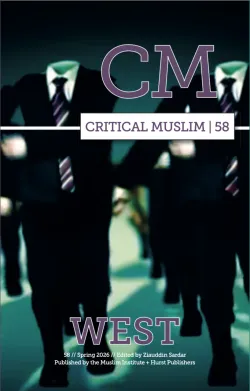
Manifest destiny is not a matter of history. It lives in the global English language we subscribe to and in the goods and services we employ on a daily basis. It is the battery charging the Energizer Bunny forward. It is a driver and one without anyone behind the wheel. And the US has become a perpetual motion machine, moving towards the same destiny even though the plot, the track, and any notion of why has been lost long ago. And the destination is destruction, existential, annihilation for all, from sea to shining sea and any rivers in between. We do not have a lot of options before us. We can carry on into oblivion like the man marching on blinded by the flag he follows portrayed in the latest Banksy sculpture that appeared in central London in April 2026. Or we can wrench the cursed battery from its casing. Or at least find a way to put all that energy to good use. We are in a perpetual energy crisis after all.
John Lietchy comes to terms with the fact that as manifest destiny proceeds to infinity and beyond, eventually there will be no more sunsets for our heroes to ride off into. Manifest destiny also turns back in on itself, and as it re-civilises the West it already won through the process of romanticising, cooling the wax seals on the justification of what has been done in the past for the great present we find ourselves in. But that’s the trick of nostalgia, that it gives the impression that the struggle was worth it, but deep down we know the destination has not been reached. Make America Great Again is an invasive paradox and none of the MAGA folks are able to cope, as they are far-too-slowly realising. Lietchy explores the romanticism of literature and film, most presciently in the films of John Ford. But he notes the film is ending and any semblance of our humanity is fading along with the rolling credits. America can only be the death of the romantic. The cowboy eventually becomes the Wall Street bastard.
While one can say that America perfected or mutilated the notion of Western civilisation, the lies and contradictions that it carried through the last two and a half centuries were inherited from the very place it claimed to have broken off from completely, Europe. Salma Khalid traces the greatest of Western lies, that it was original and superior from the first Christian church. Specifically looking at western scientific thought, Khalid reveals that the rise of the West was not some miracle out of history as other eastern civilisations had risen and develop just well on their own. In fact, when presented with the scientific products of ‘western thought’ they had likely wondered what had taken them so long to arrive at such ‘discoveries’. Through the investigation, Khalid notes that the spark of curiosity and a ‘Weberian spirit’ should have driven Western civilisation much further in its history, yet ironically the Church and the arrogance of such principles as manifest destiny drove more towards a dark age than a renaissance.
Whether we are presently heading towards a dark age or a renaissance, it remains essential to orient ourselves first and foremost. For just as much of the ‘west’ is in the ‘east’ and vice versa. And media, military, and culture have taken the map beyond geography. Ziauddin Sardar critically asks what it is we are talking about when we say ‘the West’ and then prods where exactly is it. Indeed, the US and Europe (the UK included) are very much the West, but there is a greater nuance. And in light of the recent Israel/US-Iran War we stand on the precipice of a major transition. The West, as an apotheosis is fascism and genocide, flirting with evil. If one thing has taken manifest destiny to its most monstrous adaptation, it is none other than Zionism. And in our globalised and postnormal world it is paramount that we critically oppose the Zionist adoption of manifest destiny, lest we all ride it out to its most apocalyptic ends.
Manifest is a perilous word, but it does not have to be a dangerous word. Although it has been sullied by the epistemology of western liberal thought and tainted by historical needs for justification. Perhaps the word can be saved. It is about making something clear and obvious. The pursuit of truth follows this trajectory. Zain Sardar compels us to review Harry G Frankfurt’s On Bullshit as it now rings with a stronger alarm in our post-truth, postnormal times. And yes, these noble pursuits can often be taken down pathways that result in destruction, massacre, and evil, they are not exempt from scrutiny. So, the call is not to stop manifesting. In fact, manifest we should. But in our manifesting, we must remain critical and open, not allowing hubris or arrogance to believe any of our manifestations are destiny. The only certainty is change. And there can be a certain comfort in that. Andrew Brown hopes that the only destiny before us, change, will be what might steer the West towards something more noble and more hopeful. Invoking Auden, Brown hopes that we can learn from the lessons of Rome, instead of trying to become the next Rome (complete with rise and fall) as so many have desired throughout history. Augustine’s City of God, just as Al Farabi’s Virtuous City, are good aims to aspire to. Something worth manifesting through a synthesis of world thought, taking note of the multitude of lessons to be learned.
In his article ‘Annexation’, O’Sullivan wonders if the US is destined to be ‘the great nation of futurity’. Whether cognisant or not, he was talking about power. Would the US become the nation with the power to define, with the power to establish and adjust moral parameters, with the ultimate power over ‘yes’ and ‘no’, even to define God’s will. But to me this is not how one state or another becomes ‘the great nation of futurity’. For things change in the future and we all must also change. Hubris and arrogance are fortress walls destined for crumbling. And the only obvious outcome for the US as it stands at the moment is the Fall of Rome it hopelessly waxes on about. And far too many bastards have their fiddles at the ready. All that can be manifested can be undone or, better yet, fashioned into something better. And various manifestations can be synthesised into clearer revelations.
‘Forget destiny’, Merryl would say, ‘let us start by manifesting a better tomorrow for all.’