
Must Qalandars
I am a Sindhi. You inherit something as a Sindhi. If you are lucky, you get the Sindhi language and a culture. The Sindhi language, as we know it today, retains elements that go back thousands of years, probably from the Indo–Aryan languages, linked to the Sanskrit of the Rigveda, one of the four canonical texts of the Vedas. The culture, well, that too is old and new, good and bad, and a bit of a puzzle, like all cultures. The oldness is truly old — going back to the Indus Valley Civilisation existing between 3300 and 1300 BC — and is manifested today in the Ajrak. The Ajrak is a unique form of block-printed shawl displaying deep crimson red and indigo blue geometric patterns which some say has its origins in the Indus Valley Civilisation; it is a symbol of Sindhi identity that represents the earth and the universe. Mohenjo-daro and the consciousness of that ancientness seeps into Sindhi consciousness as a manifestation of belonging. We know we are from here, we know we had a civilisation, and the superiority of colonisers just doesn’t have the same effect. It gives us rootedness.
The new in Sindhi culture is harder to chart. There has been a marked break-up of the extended family setup and rural-to-urban migration; the younger generation have adopted the Urdu and English languages, and a new generation of Sindhis, made by the cosmopolitan atmosphere of Karachi, wear Sindhiness as one among many identities. This is part of the effect that capitalism has everywhere—what Marx notes as the ‘bourgeoisie creating the world in its own image everywhere’. The distinctness of Sindhiness too melts in the mill of capitalism and its desired products of consumption. There is a viral song doing the rounds at all Sindhi weddings that encompasses this. It goes: ‘On my hand, there is a Rado watch, The car is our own Prado [a Toyota jeep], We are landlords (wealthy landowners), We live in luxury/royal style, We are the influential tribal chiefs/leaders, we have money, we have money’.
There is also, and for a long time, much that is bad in Sindhi culture. Chief among these are the hierarchies. There is the hierarchy between a child and elders—as a child I had to greet elders, particularly women, by touching their feet—chalo! Maybe that is just the adab culture of South Asia and also an acknowledgement in particular of female reproductive labour.
But then there are less benign hierarchies of caste. Every culture has its particular patriarchy; Sindhi culture does too. It is brutal: seclusion for the upper-caste women, labour for the middle class and working class, all excluded from the male domain, wages, and all with coercive violence to keep the system going.
Equally problematic are the hierarchies of caste. The high-caste individual is known as a ‘Wadero’, which literally means a person of a bigger house. The ‘person of the bigger house’ in a village, in a city, in life, lords over anyone and everyone else. Being a Wadero often comes with economic and legal power. A Wadero can call a ‘fasalo’ (decision), an informal gathering to resolve issues. Male Waderos sit as judges and their interest is paramount. Even lacking economic power, as a Wadero you can lord over all those lower in the caste hierarchy than you. I can give many examples of this, but the one that stands in my mind comes from my childhood when I was about ten years old and visiting my village. An elderly Hari (low-caste peasant farm worker) came to greet me by bowing down, gesturing to touch my feet, and then sat on the floor by my feet while I sat on a charpai—a reed string bed with a wooden frame. Nothing in philosophy or humanity justifies a fifty-year-old labouring man bowing to a child. Now the puzzle, which is the purpose of this meditation, of being a Sindhi is that while we have the poison of caste as an inheritance, we also have an antidote to it in besar Sufism. To be besar, means to be without a head. I will explain.
Sindh is known as the land of Sufis. Go to any rural part of Sindh and you see peering out in the landscape domes and atop them decorative Alams, an ornate religious stand, often in silver, letting you know of a sanctuary. In any given village you will find at least a dozen such shrines. My village, Bhiria City, has on the last count, thirty shrines. It is a small town of around 15,000 people. That is a shrine per 500 people. Overall, it is estimated that Sindh has over 10,000 shrines. If you stay in Sindh for any length of time you will see wandering, dreadlocked, black-clothed, silver-coloured pendant-wearing fakirs, sitting under trees in meditation, with a black bowl in tow. The bowl is known as a kashkul. It is for alms. People see a fakir, go into their kitchen, find what they can in their pots, they take it, and put it in the bowl of the fakir. Fakirs don’t own anything else, just the bowl, and they eat when they get food.
When I was around seven such a fakir, dreadlocked, wearing patched clothes, came and sat opposite the house of my grandmother under an old neem tree. My grandmother excitedly heated a meal of mutton biryani and gave it to me to put in the fakir’s bowl. He was deep in meditation and neither looked at me nor thanked me. He came back one more time a few days later. But I waited for him on the rooftop and never saw him again. This fakir has left in my mind an imprint of the possible purity of the Sufi path.
At about the same time, my grandmother, noting I had a fever, took me to ‘Apa Naseem’ to have an armlet of black string put on my neck for protection. Apa Naseem lived a few doors away and was born blind. She ran a small, sweet shop outside her front door—mainly for kids of the ‘Memon Mohalla’, a huge compound of houses comprising Memon Wadero families including mine. She recited a verse I did not understand, lit some leaves that let off a musky scent and smoke, whirled the leaves around me and onto the black string, and then tied the string around my neck and another on my wrist. Back home my grandmother, seeing the black thread, felt relieved and at ease for my health. My grandmother’s name, by which we never called her, was ‘Doran’, which means ‘whirl’ or ‘turning’ of an age.
That evening I went to my mother’s family house — also in the Memon Mohalla — to meet and talk to my uncle, Mammu Saban — a once dashing, super-corrupt, high-level bureaucrat, turned ascetic Islamic citizen. After spending his thirties frequenting London casinos and other haughty joints while studying at the London School of Economics, in his forties he had settled back into the village, wore simple white cotton shalwar kameez, abandoned all pretensions, grew a white beard, and instead of using his official car, walked to work, to friends, and wherever he had to go. It was an odd sight, seeing his rich flamboyant friends pick him up in their expensive jeeps, decked out in Rolexes and other vanities, while Mammu Saban had left all that behind. The study of the roulette table turned instead to the deep analysis of the Qur’an and hadith. He was a loving uncle and always spoiled me with books and discussions. As I ran to hug him, he noticed the black threads, ordered a pair of scissors, and cut them right off. I asked him why he did that; he told me this has no effect, it isn’t religion, and it doesn’t work. Religion, he said, is about being a good person and prayer. This was voodoo.
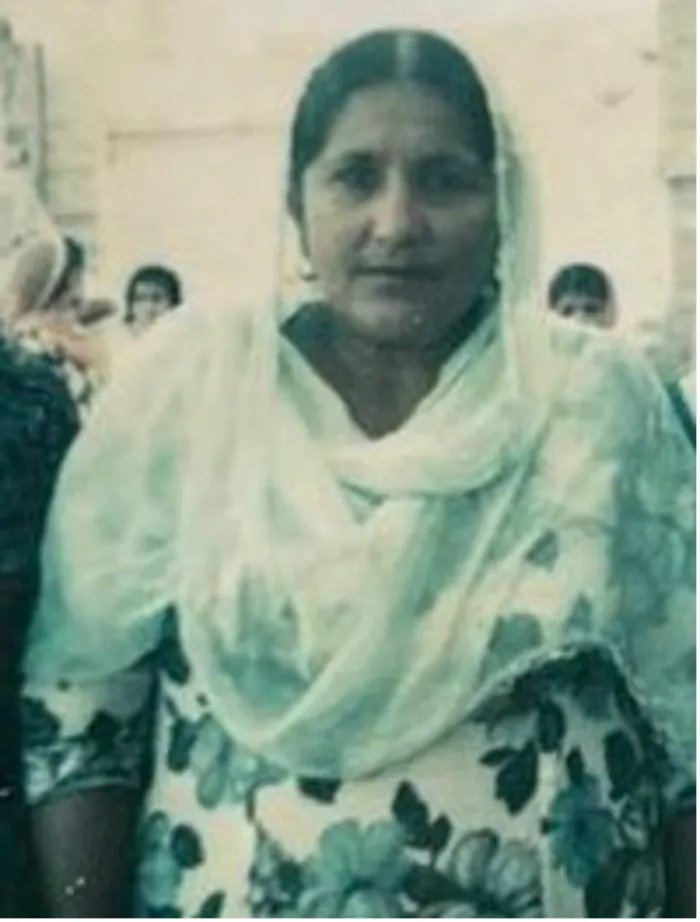
Back home, my grandmother, a matriarch who ran everything from the village marriages to politics, noticed the threads had gone. She knew the culprit was Mammu Saban; she seemed upset but not angry. The next day she sent me back to Apa Naseem’s, and again I had my magical black threads. For the next few days, I avoided Mammu Saban. It took me a few more years and studies to work out what was happening. My grandmother believed in local Sindhi Sufism, while my uncle had turned to a Deobandi school of thought and had come to a strict adherence to the visible and literal scriptural path. I was the body upon which this battle was being fought.
My uncle was in a losing battle. My grandmother was vivacious, generous, and dynamic; smiling, laughing, angry, serving up food, or supervising its serving to all those who came to the house. She welcomed everyone (high and low caste), took in the gossip, and set up strategies to counter male decision-making outside the house. She was a subaltern counter-patriarchal figure—using her influence as a senior female to fight for all good causes. She would lobby men if they were senior to her after feeding them, cultivated relations over decades and indulged their vanity for the greater good. If they were junior to her, she would simply boss them to do what she needed done. She was up at 6 am and started by making tea on a wood-fired stove, then she was busy grinding flour on a stone house mill. It was hard labour, but she took joy in work and the food she created. In the evening she served kahwa and tea, and the courtyard was busy with visitors and political strategies.
Women came in droves, taking off their burqas as they entered the sanctuary of the courtyard. They shared their problems and my grandmother would set to work on solutions; if they just needed a listening ear and tea, she would do that. Elderly senior village men came too, often after all-male village meetings to inform her of the decision from the male world, and there in the courtyard she would begin to subvert and resist what she didn’t agree with. There was a fire about her—a dynamic energy and a love of life and people that I didn’t feel in the clean, quiet, orderly house of my uncle, who had banned the radio or TV.
At night, the whole extended family would sleep in the open courtyard with mosquito nets and fans to make it bearable, and sometimes I would sleep with my grandmother. There she would tell me about ‘Lal Qalandar’, a name she too had given me.
Lal Qalandar evokes a social power and devotion unmatched in South Asia. Because of Nusrat Fateh Ali Khan and Abida Parveen and many others who sing ‘Lal Meri Pat / Mast Qalandar’, the legend and devotion have
gone further. A friend’s mother who I boarded with for many months inSurrey as a student, Liz Pugulati, knew the song ‘Mast Qalandar’ from Nusrat’s concert on the BBC, which she had on video and would play on repeat. I met at Columbia University the Marxist thinker Gayatri Chakravorty Spivak, and within moments of us being away from the formal lecture, she sang beautifully the lyrics of ‘Mast Qalandar’ with a beaming smile. While ‘Mast Qalandar’ has gone global, it is with South Asians of all faiths that it evokes something joyous. It is rare that hearing my name, a South Asian doesn’t burst into a few lines of ‘Mast Qalandar.’ The song gives the diaspora a feeling of home and fire without actual knowledge of it, and that spirit finds its way even into goras who hear it. See any Nusrat concert and the reaction of the crowd when he sings Mast Qalandar and you sense the energy of life: the body involuntarily starts moving, smiles appear on faces, hands move beyond themselves, a transcendental-like effect grips hold of all. People merge into each other; boundaries drift and melt. At one Abida Parveen concert, I could swear the whole amphitheatre was levitating. If you are from Sindh or from Punjab, Qalandar plays an even more outsized role in your life. Mine from birth.
I was named Qalandar Bux. This was also my grandfather’s name. He was a man of extremes and fire. He died in 1978, I was born in 1979, and my grandmother wanted me named after him. Qalandar Bux was a Wadero, but soon after birth became an orphan who lost both parents. He inherited some land but not as much as was his due. He spent his youth with the soil and worked to improve it, and with his Haris (peasant workers who work for a crop sharers, generation after generation), he was able to improve his income. But not by much; he was a lower-level but high-caste peasant. My grandmother supplemented the farm income by raising and selling milk from water buffalos she housed in the courtyard. My father, the eldest of seven children, too contributed by selling boiled chickpeas on a thali after school outside the Memon Mohalla.
Qalandar Bux, despite his economic means, was a high-caste Wadero and used his power to fight the cause of the village subaltern, with whom he toiled. Famously, he took on the village’s big landlord family on many occasions. Once, physically, because the landlord had attempted to seduce his lover. He was a joyous lover of life. A gambler, famous seducer, and known for his anger and corporal punishment of his children. One of my aunties broke the puritanical family self-story a few years ago and talked about him and his seduction strategies: ‘he would come to the village cinema and would hold tight his shalwar from the front to show off his toned buttocks, and the women looking from the gallery would go crazy. He had many lovers and your grandmother didn’t like it, but she too had her life and also didn’t care’. Did my grandmother also have lovers? Probably not, but she did have deep platonic relationships with many men.
To be named ‘Qalandar Bux’ means you are devoted or ‘given to’ Qalandar — the saint. When a woman struggles to have children, she goes to the shrine and vows that if a child is born, he would be ‘given’ to and named after the saint. My great-great-grandmother then would have made the journey to Qalandar’s shrine and asked for a child, once born, named him in honour of the saint, Shahbaz Qalandar.
My grandmother told me many stories of Shahbaz Qalandar. She told me how when he entered the outer limits of the central Sindh town of Sehwan, after years of learning and wandering in South Asia, the other yogis and fakirs didn’t accept him. Qalandar sat outside the town of Sehwan by the bank of the Indus. The religious figures of Sehwan gathered and, worried about the possibility of a rival, sent a young boy with a bowl full of milk to him and placed it in front of him while he meditated. The bowl signified that the town was full to the brim and it had no room for him. When Qalandar took a break from his meditation and saw the bowl, he got up and from the riverbank took a lotus flower and placed it on top of the bowl. The flower floated perfectly without spilling the milk. The errand boy took back the bowl with the flower on top, and the yogis and fakirs seeing this smiled and welcomed Qalandar into the city. Qalandar had replied that even though the town was full, it had room for a flower.
Another story my grandmother told me concerns a beautiful female, an intellectual and spiritual companion of Qalandar, who was abused by the local ruler. Learning of this, Qalandar, in the words of my grandmother, ‘got angry and his anger caused an earthquake that destroyed the houses of the rich and rulers and vanquished them in the rubble’. In another telling of the same story, Qalandar, in his fire and anger, ‘turned the town upside down’. My childhood imagination struggled with this. But when I read the French West Indian psychiatrist and revolutionary Franz Fanon many years later, it made more sense. Fanon defines revolution, quoting Matthew, ‘as the first shall be last’. When we would visit Sehwan, there would be a mound of mud high up above the shrine which was shown to me as the site of where the ruler’s settlement had been and had been brought to rubble by the anger of Qalandar. These myths—the miracle birth of my grandfather on asking from the saint from my great-grandmother, Qalandar the defender of women’s honour, protector of the weak, the nurturing of heavenly forces to vanquish the oppressors—made my father’s side of the family firm devotees. My childhood was filled with near-monthly visits to the Saint’s shrine.
Lal Shahbaz Qalandar’s shrine is located in the heart of the town of Sehwan, in central Sindh, near the River Indus and the great Manchhar Lake to the west, with a vast plain to its north. These three sources of water and fertile land explain why it is one of the oldest continuously inhabited towns in the region. At one time it was known as Siwistan — meaning the ‘abode of Shiva.’ It was the site of a famous Shiva temple and Shiva jogis lived in the town. Even further back, oral history tells of it being the site of a Zoroastrian fire temple. Which, if you have visited Sehwan, makes perfect sense. Fire is indeed how I remember Sehwan. I often went in the summer and as you step out of the vehicle the heat hits you. It’s not only that it is hot from above and the sun, reaching 50 degrees Celsius sometimes in the summer, but there is a fire coming from the earth itself, which you feel as soon as you step on it. The town’s ground is baked, ashen, and dry. Within a few minutes, you adjust to the heat and rather than sapping your ability to move, it hastens you, makes you alert and alive.
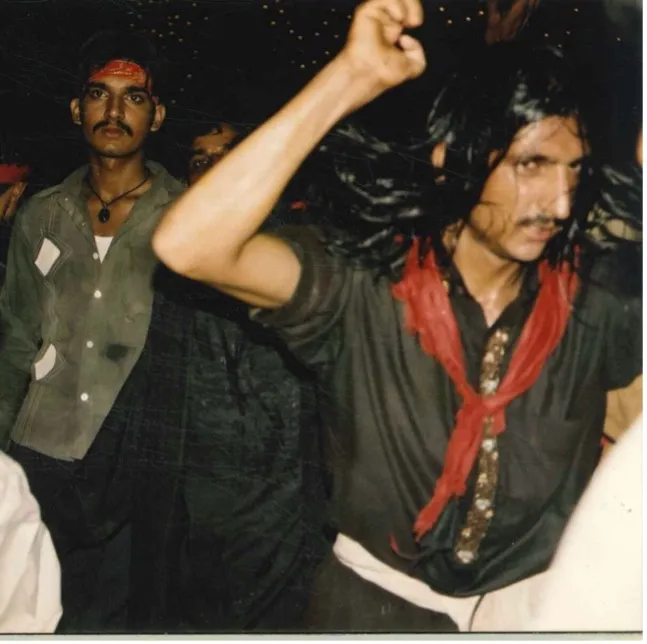
Inside the shrine, out of respect, you take off your shoes and move in the courtyard with burning feet on the marble. I have seen the shrine in two incarnations. In 1994, it was rebuilt with a golden tiled dome and marble courtyard. Since the 1970s, it has had gold-plated doors donated by the Shah of Iran. Prior to 1994, the areas surrounding the shrine were often baked earth paths; Qalandars and Hindu women lingered, and many homeless people, some dogs, and many birds made it their main residence. Inside the shrine building, you smell the roses that people have offered and the burning incense. They also bring ajraks, block painted shawls, to bestow on the grave of Qalandar. The grave is covered by a wooden canopy and iron grills; people, in their devotion, touch any part and say their prayers. It is a profound sight to see men and women losing themselves and letting down the masks we wear in desperate prayer and call for support from the saint. At one time, people tied threads with their prayers to parts of the grill around the shrine—my great-grandmother being one of them.
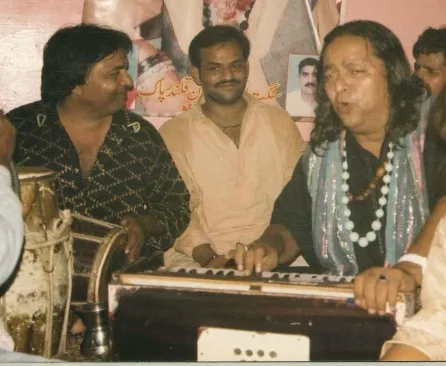
We went to the saint before weddings, after weddings, to give thanks for the birth of children, to ask for support in illness, and even, in the case of my father, we went before and after a big review in his banking career for promotions or transfers to London—which he always wanted. The trips I remember the most are wedding related. It is a Sindhi tradition to collect water from seven sources for a ritual washing of the feet of the bride and groom. Collecting the water itself is akin to Bacchic festivities; and I have always felt Qalandar to be in part a continuation of Dionysian and Shiva worship. We go with dhols (drums), flutes, among other instruments, singing and whirling to the riverbed, draw water in clay pots, and return in the same way—dancing, singing, whirling. The family women would do the singing of folk songs and beat medium-sized drums. Sometimes we would employ local musicians to accompany us, but often the family had the required talent. We had already collected water from our local canal banks; now, in vans, we travelled to the Indus near Sehwan and, after collecting the water, we head to Qalandar’s shrine. The drum beat all along the four-hour journey and my cousins sang song after song — including ‘Mast Qalandar.’
‘Mast Qalandar’ was written by the thirteen century Sufi poet Amir Khusrow. It was modified, in the eighteenth century, by Bulleh Shah, the Panjabi revolutionary reformer, philosopher, and poet. It gives us only a partial understanding of who the historical Qalandar was. The lyrics go:
Oh Lal, keep my honour safe, O swaying Lalan
From Sindh, the beloved one of Sehwan
O friend, the majestic saint Qalandar
Forever intoxicated, the ecstatic Qalandar
Ali is within every breath
my Lal
Four lamps forever illuminate your path
The fifth has come to bless, O swaying Lalan
In India and Sindh, your glory resounds
Along with the drums, O swaying Lalan
May there always be well-being for you, O beloved
With the name of Ali, the pain is relieved, O swaying Lalan
Qalandar is an honorific title which is given by other Sufis to the one who they believe has reached the highest level of spiritual knowledge. The Qalandayyi order (the way of those on the Qalandar’s path) is a nonhierarchical order (so it has no order at all); they are anarchists and don’t believe in centralised order and pirs. They do, however, believe in the mystical path and honour exemplary ones with the title Qalandar. How one becomes a Qalandar in this honorific sense, therefore, is not through an institutional process — like becoming a cardinal or bishop — but a process of dialogical acceptance by the community at large and other fakirs that someone has reached a high exemplary existence. There are three known ‘Qalandars’ given this honorific title: Shahbaz Qalandar; Bu Ali Qalandar, who flourished in the thirteenth century and has his shrine in Panipat, India; and Rabia Basri, the eighth century poet and Sufi mystic of Iraq. While the fakirs of the Qalandar path do not believe in formal institutions, they do believe in methods and a path. The song Mast Qalandar evokes some elements of this method—particularly by referring to the importance of being mast — in a trance-like state.
Behind the shroud of Lal Qalandar is the historical figure of Usman Marwandi. We know little about him. He was born in 1177 in the region of Marwand. He travelled and studied in Syria, Iraq, and Mecca before being advised by Bu Ali Qalandar of Panipat to head to Sehwan and settle there. Lal Qalandar wrote treatises on religious practices that are now lost. Many poems attributed to him are disputed; what remains are ghazals in Persian, which are likely to be his. The most famous is Mi Raqsam, which can be translated as ‘I am dancing’. It goes:
I know not why, at the moment of the vision, I am dancing
I am proud of this ecstasy, that before the Friend, I am dancing
Come, O singer of the gathering, begin the music and the joy
For I, in the circle of the reckless seekers, am dancing
I am Usman of Marwand, friend of Master Mansur
The world reproaches me, yet upon the gallows, I am dancing
In the ghazal Lal Qalandar claims to be the friend of the original firestarter: Mansur al-Hallaj. Mansur took on political and religious authority in tenth century Baghdad by proclaiming a horizontal relation of God to all. Neither the mullah nor king was special or divine — all were the ‘Truth’. For his anarchist philosophy, Mansur was sent to the gallows. Lal Qalandar, likewise, admonishes the literal path of prayer mat and prayer beads. Love, joy, recklessness, dance, and martyrdom for truth, are the path to the ‘Friend’. Mansur was a martyr for the truth, and Lal Qalandar too belongs to the continuing line of be-sar fakirs. Be-sar literally translates as ‘headless’, but it evokes a willingness for martyrdom by decapitation. After Lal Qalandar came many be-sar fakirs in Sindh.
Most famous is Shah Inayat of the town Jhok Sharif, Sindh. He was granted land by the Mughal court in the late seventeenth and early eighteenth centuries for his family’s religious work. On this land, he set up a commune and invited peasants to farm and take the goods of their labour. The land was a religious grant and, therefore, tax-free. The local landlords did not like the example he was setting and attacked Shah Inayat’s commune. He armed the peasants but also complained to the Mughal court. The court ruled in his favour and granted him the land of the attackers. Shah Inayat, therefore, further expanded his commune and over forty thousand peasants took refuge in this egalitarian society. The size and example of the commune now worried even the Mughal court, and they turned on Shah Inayat and sent an army from Delhi. Surrounded by the Mughal army and the fighters of the local landlords, the commune held out as best as it could. Shah Inayat was lured out for negotiations but betrayed and captured. He was decapitated and his head sent to the emperor in Delhi.
Shah Inayat’s life illustrates that the fakirs of the be-sar Qalandar tradition were not apolitical renouncers and dancers but also political revolutionaries supporting the oppressed and prepared for the ultimate sacrifice for the beloved. The beloved is the oppressed, the downtrodden, the subaltern and, in our particular society, the Hindu low-caste and women. ‘Mast Qalandar’ is a fired-up body moving and dancing for justice — for the beloved. Other be-sar fakirs include Bulleh Shah of Punjab and the patron poet/fakir of Sindh, Shah Abdul Latif, who had Shah Inayat as a teacher. This love for justice and subaltern fight is also embodied in some everyday followers of Qalandar. I think my grandmother embodied that in her own way.
I don’t know if it is the Zoroastrian fire, the fire of Lord Shiva, or the dancing of Lal Shahbaz Qalandar—probably it is the fire of and whirl of energy created by the hundreds of millions of pilgrims who over hundreds of years have visited Sehwan—but a fire is there in Sehwan. I feel it. You will feel it too. I can’t rationally explain it, but I am happy to live it, provided it is geared towards a goal greater than myself. It is joyous and rebellious and, when geared towards justice, it is immortal.
I think now that however irrational it is (and it is irrational) to think a black thread was going to save me from illness, this practice functioned to connect women in my village and empower their network. It gave them a counter-epistemology to fight the closure of women from formal religious institutions of the village. The world of my uncle was a male world of the masjid, mullahs, and patriarchal power. Qalandar and his fire lived through my grandmother Doran and Apa Naseem and many other women connected to something through these practices that the Mullahs couldn’t take. The ancient fire of the besar martyrs of the subaltern moved this way, danced through them, and that is what Qalandar and Sehwan are for the millions that go on pilgrimages there — a place to gather an ancient fire for those grave, difficult battles of life.
I am proud to be a Qalandar — if only in name!