Guernica: Things to Come
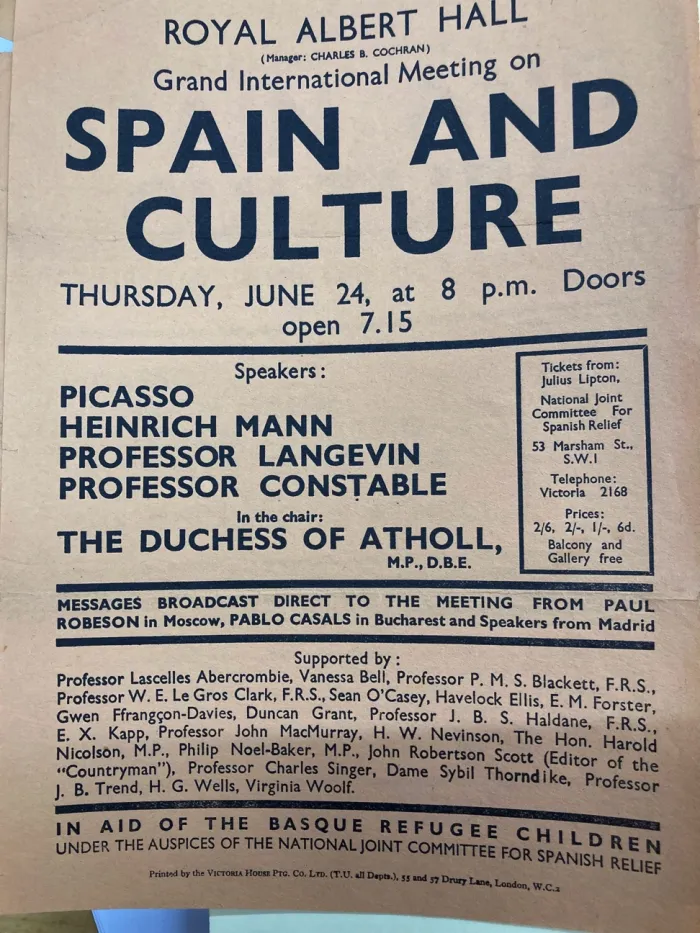
On 24 June 1937, a mass meeting was convened by the National Joint Committee for Spanish Relief in aid of refugee Basque children at the Albert Hall, London. Picasso was billed to speak but sent apologies, he was working against the clock painting Guernica in response to the brutal Nazi bombing of the Basque town of Guernica on 26 April 1937. The meeting was chaired by the ‘Red Duchess’, Katherine, Duchess of Atholl, conservative Member of Parliament, author of 1938 book Searchlight on Spain. The treasurer was Roland Penrose, artist and patron, the supporters were left leaning politicians and luminaries of the arts and sciences, signatories of an open letter to The Times in support of the Spanish Republican government. Guernica, the icon of anti-war paintings, and its creator were at the eye of the storm which was the Spanish Civil War 1936–1939. The conflict, loosely between Fascism and Democracy, with political, religious, and class divisions, impacted worldwide. It both divided and galvanised artists. In Britain, the Artists International Association (AIA) founded in 1933, joined the Popular Front of anti-Fascist political forces in the Republican cause and in the attempt to resolve the post war crisis of democracy. To this end Picasso was persuaded to allow Guernica to tour to England in 1938–1939. As a major political commission Guernica is an exception in his oeuvre, it is also the distillation of his art, a fevered expression of his private demons and pain, fuelled by outrage at human barbarism. As John Berger said, it is a profoundly subjective work. Picasso described it as an allegory. Its chilly grey imagery, cubist surrealist in style, both impressed and mystified the public, and prompted fierce critical controversy – then as now. That it failed to influence events was as much to do the fragility of democracy as it was to the complexities of the work itself.
Guernica’s gestation and exhibition are the sum of a complex personal and political history. Picasso travelled freely between Spain and France after he settled in Paris in 1904, but as Fascism took hold in Spain attempts were made to petition him to return. Picasso was flattered by the offer of a retrospective in Madrid, which the Republicans had failed to fund. He attended a dinner at San Sebastian’s Café Madrid, a Falangist haunt, charmed by its founder José Antonio Primo de Riviera. But he last set foot in Spain in September 1934. He spent the rest of his long life exiled in France. The cumulative impact of events in Spain had an inevitable and profound impact on Picasso’s work long before the tragedy of Guernica. Under pressure from the reactionary factions of Catholics, Fascists, Falangists, and the military, the Spanish Popular Front government just held as the left split into factions. By 1936 the country descended into anarchy and Civil War. Picasso was embroiled in his own private wars, with two mistresses, one, Marie-Thérèse Walter, pregnant, and he was contemplating divorce from his wife. His inner turmoil found expression in his greatest etching Minotauromachy, 1935. Evolved from seven plates or states, it is dense with opaque imagery: a Christ like figure, a woman, a monstrous minotaur, horse, a young girl, which confound straightforward interpretation. It is the precursor of Guernica.
Appalled by the success of General Franco’s Nationalist rebel forces supported by Hitler, Picasso suffered a further blow when his friend the poet Federico Garcia Lorca was executed on 19 August 1936. In January 1937, Picasso met with politicians and members of the Alliance of Anti-Fascist Intellectuals for the Defence of Culture and agreed to paint a large mural for the Spanish Republic’s pavilion at the Paris International Exposition opening in May. With the Pavilion commission, Picasso was officially harnessed to the Republican cause. His early design was tentative, Painter and Model 19 April 1937 incongruously sports the Communist fist with hammer and sickle. The symbol had first appeared in 1936 in his drop curtain for Romain Roland’s play Le 14 Juillet, a celebration of the election victory of France’s Leon Blum’s short-lived Popular Front government. On 27 April 1937 came news of the carpet bombing of Guernica, (Gernika in Basque), by the Nazi German Luftwaffe and the fascist Italian Aviazone Legionaria on behalf of Franco, obliterating the town and killing civilians. It was immediately reported in graphic detail by George Steer in The Times which ran the story every day for a week and syndicated it worldwide. In Paris, L’Humanité published grim photos of death and devastation. Basque refugees flooded into France and thousands of Basque children were evacuated, many to Britain. The bombing caused widespread panic and fear of what was to come, in Britain as well as Spain. Like Salvador Dali’s monstrous work Soft Construction with Boiled Beans (Premonition of Civil War)1936, British surrealist paintings, such as Pro Patria 1938 by John Armstrong, designer of the apocalyptic Alexander Korda film Things to Come 1936, are suffused with destruction and desolation. The atrocity was thought to be without precedent; the fact that saturation bombing had been used earlier by western colonial powers in the Middle East and Africa was forgotten. Franco’s propaganda denied Nationalist involvement. Picasso had his subject. The Socialist politician, later Spain’s Prime Minister, Juan Negrin, agreed to fund the project believing that ‘the presence of a mural painted by Picasso is the equivalent value in propaganda terms of a victory at the front’. He would be disappointed.
From his rapid first pencil sketch on 1 May 1937, to over thirty studies and several states through to the completed work, Picasso forged and cannibalised images which are at the core of his art: images of primal, often sexual, violence and human suffering. The sacrificial bull, the fallen gored horse, weeping woman and child, the flaring light, the woman with the lamp are constants throughout his work. These have generated myriad interpretations, plumbing Picasso’s psyche and personal relationships, Spanish history, religion and culture, art historical and mythological sources. In Guernica’s female figures the doomed women in his life are clearly recognisable. Importantly, Picasso made no direct literal reference to the bombing, or to contemporary warfare, there is none of the grim hardware of the modern military. The Communist raised clenched fist of the fallen soldier in the first state is erased. Picasso famously said in 1935 ‘a painting is the sum of its destructions’, but there had been early illfounded rumours of him painting the Soviet leaders which made him then acutely uncomfortable with being associated with Communism.
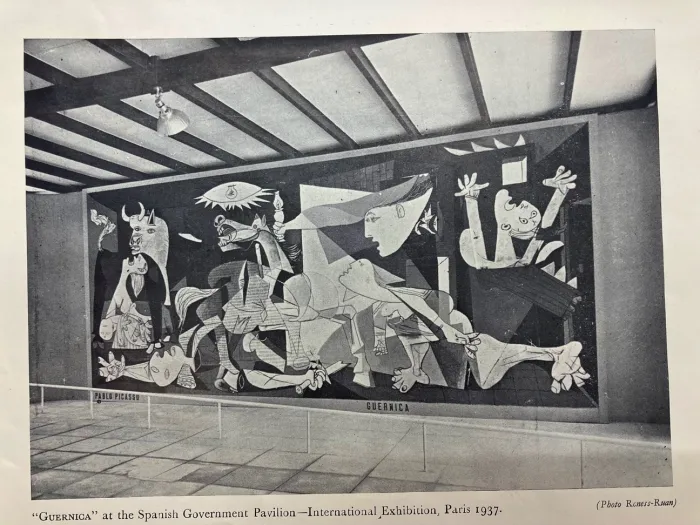
He was adept at working fast and at scale from his early collaboration with the theatre impresario Diaghilev. Guernica’s rapid creation, stage by stage, was documented in a sequence of photographs by Picasso’s then lover Dora Maar which give unprecedented insight into Picasso’s fevered working over five short weeks. Maar’s left activism, she was a member of the ContreAttaque anti-Fascist group and a signatory to their manifesto, and her political conviction and tragic melancholy profoundly impacted Picasso and found expression in his subsequent paintings of suffering and death, weeping women, skulls and still lives. Her brilliance as a photographer undoubtedly influenced Picasso’s decision to paint Guernica in matt grey monochrome. It is a theatre of pain, of tortured forms, projected, freeze framed on dark voids, its scale and form unlike any other contemporary painting. The work confounded the critics and public alike when the Pavilion finally opened on 12 July. With its uncompromising extreme modernist style, it was in stark contrast to the less challenging or overtly propagandist work in adjoining Pavilions. The British Pavilion, with gentle domestic scale paintings by John Nash and fellow artists was hardly likely to raise the heartbeat, or the political temperature. It was indicative of the ill-judged non-interventionist position of the British Government to the Civil War.
Picasso’s work was shown alongside contemporary Spanish artists and photographs presenting graphic images of the war and propaganda of Republican reforms. The most popular work with the Communists was the painting, Madrid 1937 (Black Aeroplanes), of bare breasted mothers with babes in arms cowering under falling masonry by the realist Horacio Ferrer de Morgado. Guernica’s official reception was cool, the Basque President declined Picasso’s offer of the work for the Basque people. The Basque painter Jose Maria Ucelay vilified Picasso, declaring the work pornographic; Le Corbusier was dismissive, not a single French newspaper wrote about it. Intellectuals thought it was too sophisticated for the workers who were anyway preoccupied by films, performances and the café nearby. Anthony Blunt, prominent British critic, later infamous Soviet spy, famously denounced it in his 6 August 1937 Spectator review as obscure, ‘a private brain-storm which gives no evidence that Picasso has realised the political significance of Guernica.’ This charge was later to be amplified by a long running public argument in the Spectator between Blunt and fellow critic Herbert Read which set the course for Guernica’s tour of England the following year. This was primarily the initiative, not of the AIA, but of Roland Penrose ‘so that the British public might finally be allowed to see for themselves whether Blunt’s criticisms amounted to more than Marxist dogma’.
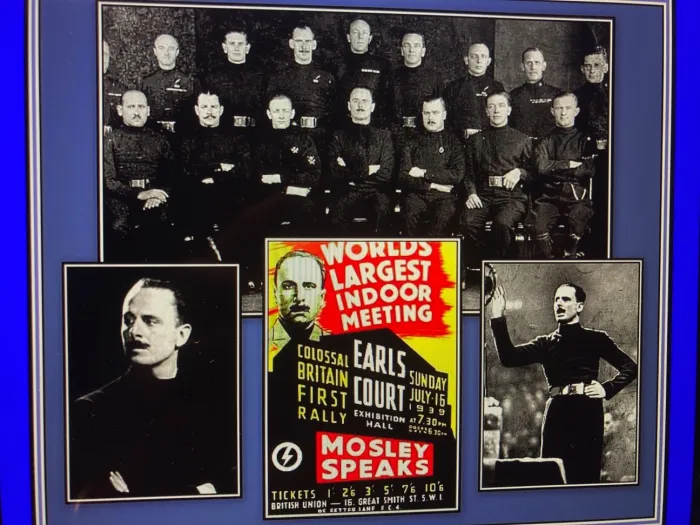
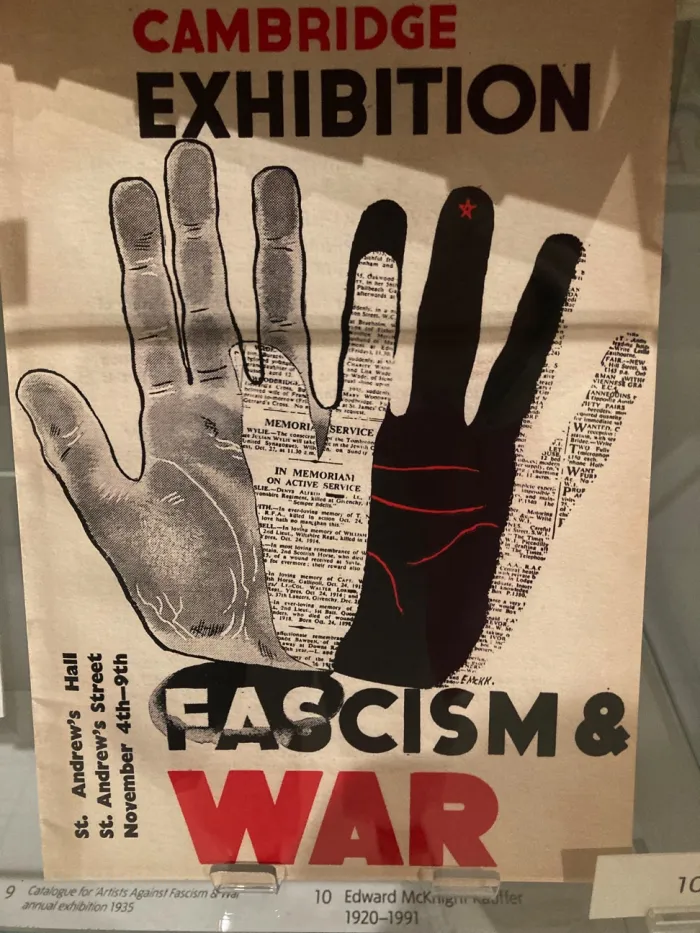
Picasso was persuaded to allow the painting to go to England to support the fundraising of the National Joint Committee for Spanish Relief, he wrote it was ‘to draw attention to the horrors of war and it must take its chance’. The Committee and patrons were left wing politicians, scientists, artists and poets, including Penrose, E.L.T. Mesens, Herbert Read, Victor Gollanz, E.M.Forster, and Virginia Woolf. With the emergence of the British Union of Fascists in 1932 led by Oswald Mosley, the Committee was part of what, following France, became a British Popular Front against Fascism and War led by the Trade Unions, The Independent Labour Party (ILP), the Communist Party, AIA, and other groups which was at odds with the policies of the mainstream parties. In October 1936, the Labour Party conference rejected the affiliation of the Communist Party. The Front held an unprecedented series of anti-Fascist public events and exhibitions through the 1930s to support the Republican cause, to raise arms and to fundraise for food and refugees and to challenge the conservative led British National Government policy of non-intervention. In October 1936, Penrose went to Catalonia and brought posters and legendary photos from the front by the great war photographer Robert Capa for exhibition in aid of Spain. The Front regarded exhibitions as ‘demonstrations’, interventions for a political and social cause. The AIA’s first decades were an unprecedented political project galvanising artists across the board, including architects and commercial artists; modernist artists were a minority, although Picasso and other European artists sent work to AIA exhibitions. The AIA held their exhibition Artists Against Fascism and War in Cambridge and London in1935 when Italy invaded Abyssinia, and followed with the first British Artist Congress ‘For Peace, for Democracy, for Cultural Progress’ in the radical Conway Hall, London, in 1937. The Association showed work in the Peace Pavilion at the Paris Expo and held an exhibition of Chinese woodcuts in solidarity against the Japanese aggressors in Manchuria. The cartoonists and graphic artists came into their own, producing pamphlets, newsletters, posters and illustrations for the Left Review (1934-1938). Intellectual freedom was also at stake and The Association of Writers for Intellectual Liberty was formed in 1936. Writers, including H.G. Wells, T.S. Elliot, Tristan Tzara, and Picasso’s friend Pablo Neruda published a pamphlet in June 1937, ‘Authors take sides in the Spanish War’ posing the question ‘Are you for, or against Franco and Fascism?’.
Guernica arrived in London 30 September 1938, the day that British Prime Minister, Neville Chamberlain returned to London declaring ‘Peace in Our Time’ after signing the perfidious Munich Agreement. In October, Guernica was shown at the prestigious New Burlington Gallery, Mayfair, with over sixty preparatory studies alongside Picasso’s grief-strickenpainting Weeping Woman, war planes reflected in her eyes, which Penrose had bought from Picasso after it was completed in October 1937. He considered it ‘a postscript to the great mural that contained a cry of agony caused by the fascist government on humanity’. The adjacent gallery was later hired by supporters of Franco who showed a large painting of the Nationalists’ defence of the Alcázar of Toledo in 1936 by Franco’s favoured academic artist Ignacio Zuloaga. His supporter was Lady Ivy Chamberlain who was awarded the Gold Medal of Merit of Italy by Mussolini. The Times and The Observer gave Guernica poor reviews. Guernica attracted just 3000 visitors; Penrose wrote to Picasso of his disappointment, putting the lack of crowds down to ‘the crisis and the general demoralisation’.
Guernica’s reception also reflected the deepening divisions in British art between the realists and the modernists. Picasso’s most overtly political work, two sets of etchings and a poem, The Dream and Lie of Franco, was made just after Guernica in June 1937 in aid of the Spanish Refugee Relief Fund. In the form of a comic strip, postcard images savagely lampoon the General as a stage strutting, sword brandishing deformity, astride a disembowelled horse, brilliantly evoked by Picasso’s poem:
Rage that contorts the drawing
Of a shadow that lashes teeth
Nailed into sand the horse
Ripped open top to bottom
in the sun...
The work’s grotesque excess was denounced by Anthony Blunt in his Spectator review of 8 October ‘the etchings cannot reach more than a limited coterie of aesthetes’. Blunt, who promoted the Mexican political muralist Diego Rivera, took the realist position of the AIA’s influential Marxist intellectual, Francis Klingender. The AIA Newsletter of January 1938 saw ‘the bad influence of Expressionism, Surrealism, Futurism and Abstraction.. as fantastic and far less comprehensible than Goya’s work in denunciation of war.’ Goya’s great series of etchings the Disasters of War was exhibited that July at the Victoria and Albert Museum, London. Herbert Read argued cogently for Picasso and the revolutionary power of modernism in a letter to the Spectator 15 October 1937 where he had described the painting as a ‘modern Calvary’. Writing in the London Bulletin of October 1938 he saw in Guernica’s imagery, not the realism of Goya’s Disasters of War, but universal symbols ‘it is only when the commonplace is inspired with the intensest passion that a great work of art, transcending all schools and categories is born’. Thirty years later, Blunt came round to Read’s view. Both critics were pre-empted in their recognition of a masterpiece by the artist Myfanwy Evans, wife of the British artist John Piper who wrote a penetrating analysis in her 1937 collection of essays The Painter’s Object: ‘least of all is it a ‘Red Government’ poster screaming horrors to a panic-stricken intelligentsia. It is a passionate recognition of the facts, so purged as to become almost detached statement, and ultimately so unrealistic as to be almost as abstract as his most abstract painting. Yet only a Spaniard could have done it…’
From Mayfair Guernica moved to the East End of London and to a very different but not uneducated public. In the 1930s, the East End suffered extreme poverty, it was the socialist heartland of London with a population of a quarter of a million people, including anarchists, communists and many immigrants, Huguenots, Irish, Chinese, Jewish, Bangladeshi, Somali. They were victorious at the famous 4 October 1936 Battle of Cable Street, fought against fascist Oswald Mosley’s Black Shirts. The Whitechapel Art Gallery, like the New Burlington, was distinct among London cultural venues for its progressive and non-conformist exhibitions. Under its first Director, Charles Aitkins, the programme was eclectic and transnational aiming to serve its local community, promoting knowledge and solidarity. Early shows included modern European art and that of non-western cultures such as the landmark 1908 Muhammadam Art and Life. The Gallery was also next-door to the Whitechapel Library, known as The University of the Ghetto. In the 1930s, the Yiddish and Judaica sections were the largest in the country. The Library was a learning and meeting place not only for the East End’s many immigrant intellectuals, including Jewish artists Jacob Epstein, Mark Gertler, and David Bomberg, but autodidacts, working people and their children.
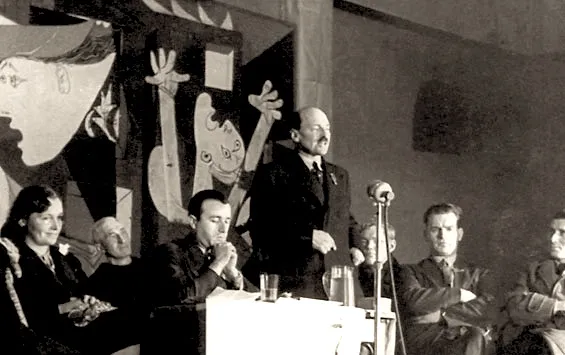
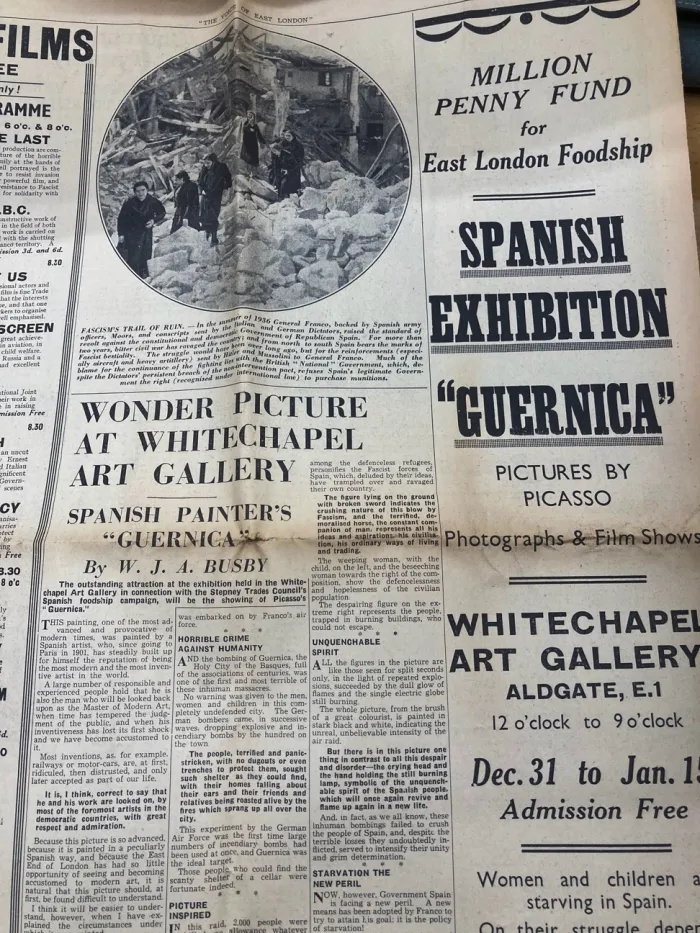
Stepney Trades Council East London Aid Spain Committee, a front for the local Communist Party, privately hired the Whitechapel Art Gallery to show Guernica from 31 December to January 1939 for their Million Penny Fund. The entrance fee was a pair of serviceable working men’s boots. It was a coup, especially as the Gallery’s founder Trustee took the view that the Whitechapel people ‘have to be delicately led’ and that the ‘krinks and kranks of modern art movements’ were not to be encouraged. The exhibition, attended by the Mayor and the Secretary of the Stepney Trades Council, flanked by members of the International Brigade, was opened by Clement Attlee, a former Mayor of Stepney, MP for Limehouse and Leader of the opposition Labour Party who had served as a Major in the Territorial Army. He had earlier been a volunteer manager of a charitable club for working boys in the borough of Stepney. On 7 January, the East London Advertiser reported Attlee’s rousing opening speech where he rounded on the Prime Minister ‘Mr Chamberlain said he was a realist but he did not show much realism in his dealing with dictators. He told them over and over again that he completely trusted the word of Signor Mussolini.. If once Fascism gets a hold, the people who suffer most will be the young’.
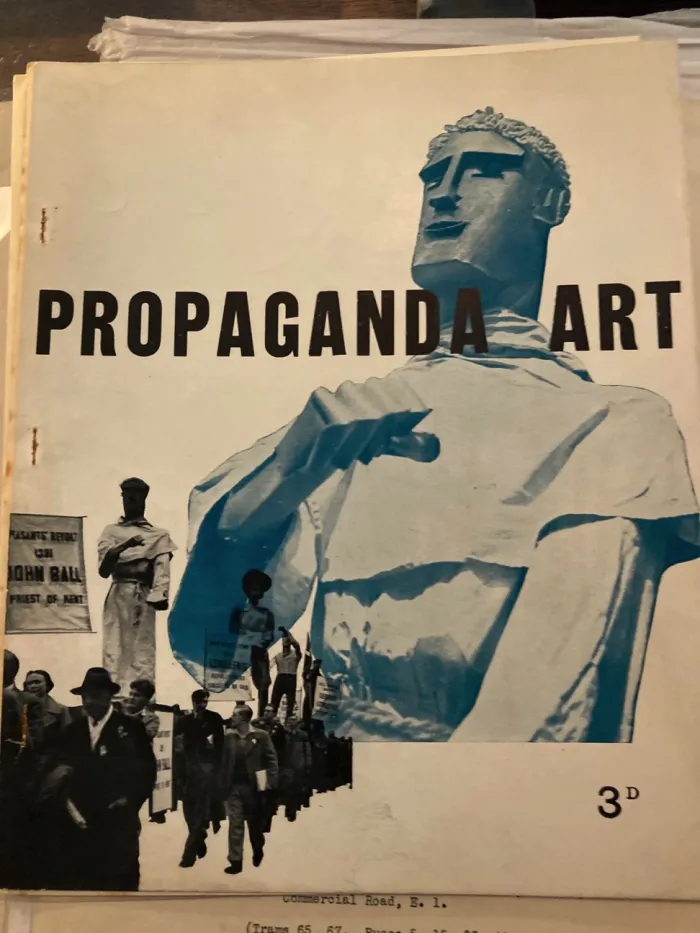
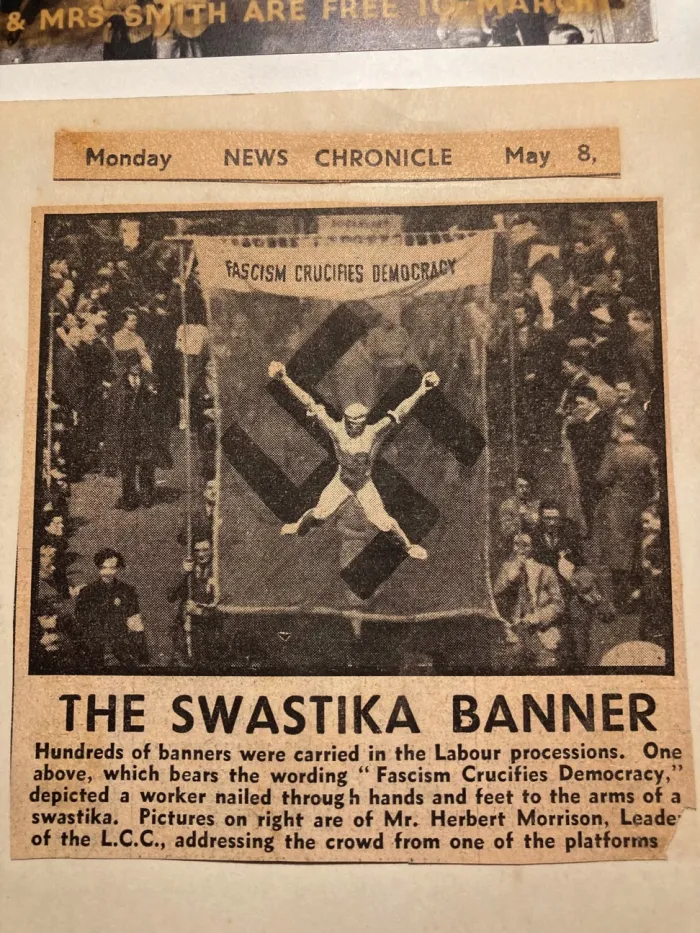
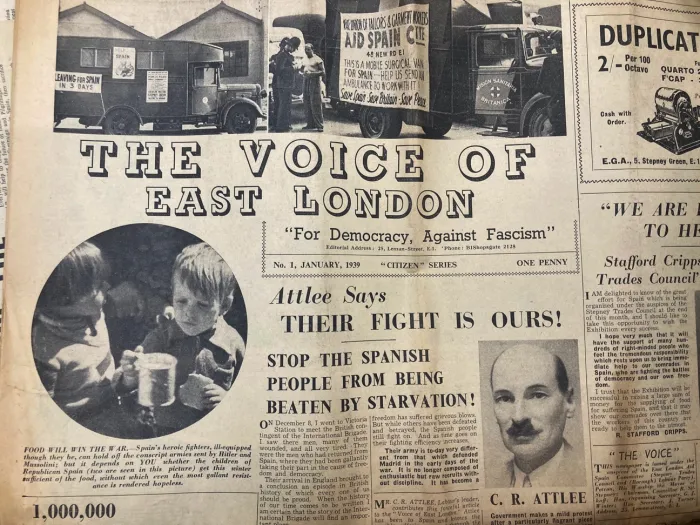
Stepney’s Trade Council agenda was entirely political, Guernica was to spearhead their propaganda campaign. Communist Party member Norman King left some of the few extant records, including photographs, of the opening of the exhibition in the Whitechapel Gallery archive, donated by his widow in 1998. King lived in Shadwell in the East End, he was a commercial photographer and holder of the Tolpuddle Medal for Trade Union recruitment. He recognised the power of visual images and ran “Propaganda and Art’ Courses for trade union activists to teach graphic design skills for placards for anti- Fascist marches and labour causes. An exhibition of work was opened by the Labour politician Herbert Morrison, MP for Hackney South and powerful Leader of the London County Council. Guernica received an enthusiastic but cautious welcome as the ‘Wonder Picture’ in the The Voice of East London January 1939: ‘Because this picture is so advanced, because it is painted in a peculiarly Spanish way and because the East End of London has had so little opportunity to seeing and becoming accustomed to modern art it is natural that this picture should, at first, be difficult to understand’, concluding that the whole was expressing the ‘indomitable spirit of the Spanish people’. Films on the Spanish Civil War were screened and talks given by Penrose and other luminaries. The News Chronicle of 9 January 1939 reported 15,000 visitors, but Guernica raised just £250 for the Million Penny Fund.
Much was expected of Guernica and much was at stake. The drawings had been shown at Oxford University, Leeds Art Gallery and again in Oxford for an exhibition organised by the New Oxford Art Society and Denis Healey, future Labour party politician. Guernica’s last showing in Britain was from 1-15 February in a car showroom in Manchester in aid of a Food Ship for Spain where the Manchester Evening News reported on 31 January,‘people will see it and puzzle over its meaning’.
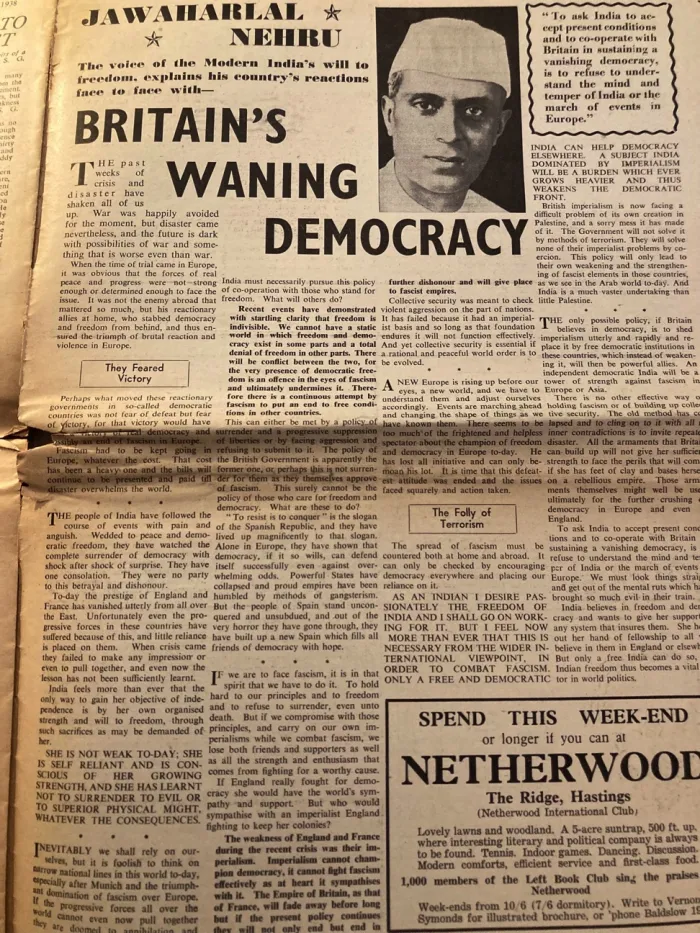
Expectations of the work to affect change were high, not only in the context of Fascist Spain, but in the growing unease in Britain among the left at the deepening erosion of democratic values. H.G.Wells published Democracy Under Revision in 1927, Leonard Woolf article ‘Is democracy failing’ appeared in the 7 October 1931 edition of Listener. Sir Stafford Cripps in 1933 published Democracy and Dictatorship, The Issue for the Labour Party, addressing unequivocally the constitutional difficulties of achieving reform of existing ‘democratic’ institutions. With three million unemployed in 1931, the National government had introduced means testing of benefits which led to the Hunger Marches of 1932. In 1934, the Incitement to Disaffection Bill sought to criminalise any attempt to dissuade members of the armed forces from service and was widely seen as an attack on free speech and civil liberties. It led to the foundation the same year of the National Council for Civil Liberties. Attlee was among the vice-presidents. Guernica’s exhibition had the blessing of Cripps, leading spokesman for the left and co-founder of the Tribune the oldest democratic socialist paper established in 1937. In its 28 October 1938 edition, Tribune published Cripps on imperialism and justice in foreign policy and Jawaharlal Nehru on Britain’s waning democracy and imperialism, making an early call for Indian independence: ‘Imperialism cannot champion democracy, it cannot fight fascism effectively as at heart it sympathises with it’. The failure of the League of Nations to stem Japanese and Italian aggression, the rise of Fascism in Europe and the Spanish Civil War and the advocacy of Trade Union leaders to support the Spanish Republicans, forced the Parliamentary Labour Party, which had opposed rearmament, to change its defence policy, if not its position on the colonies. Morrison shifted his pacifist position, although others, such as Aneurin Bevan and Stafford Cripps, held to their minority socialist position aligning with the anti-imperialist Popular Front policy then advocated by the Soviet Union.
The Communist Party was held by many then to be anti-Fascist and had strong roots in the founding of the AIA at a time of acute unemployment in Britain. Artists were attracted to work in the USSR which was employing foreign graphic artists for propaganda purposes. Founder member Clifford Rowe came back from Russia after his monumental painting of the Trafalgar Square Hunger March, commissioned by the Red Army, was exhibited in Moscow. He proposed the idea of an ‘International Organisation of Artists for Revolutionary Proletarian Art’ which became the AIA, recruiting over 1000 members aligned to fight Fascism ‘Against Imperialist War on the Soviet Union, Fascism and Colonial Oppression’. The fine artists were trumped by the ‘strip cartoonists and the silk screen people’; the cartoons of James Boswell, Ralph Laurier and others produced biting commentary on current events. The AIA painters embraced a new realism, looking back to William Hogarth and Goya, basing their banners and hoardings on Goya for an ‘Arms for Spain’ demonstration held in Trafalgar Square in February 1939 and for their paintings for an ‘Art for the People’ exhibition at the Whitechapel Art Gallery. Artist Nan Youngman invited an unemployed man off the street to open the show, it was ‘intentionally didactic …We wanted everyone to use their art, whatever it was, in a political way’.
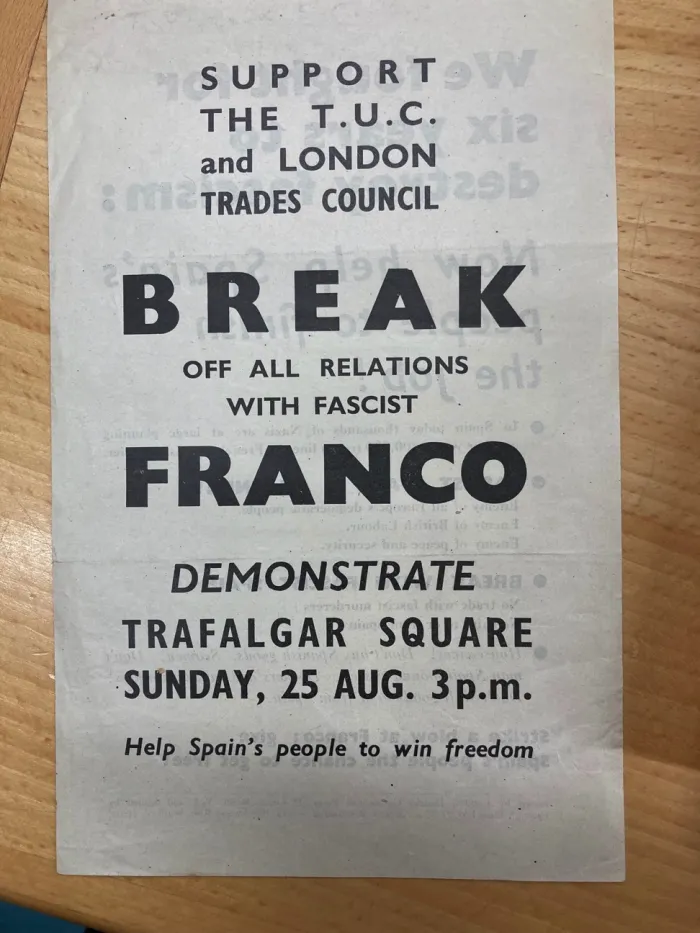
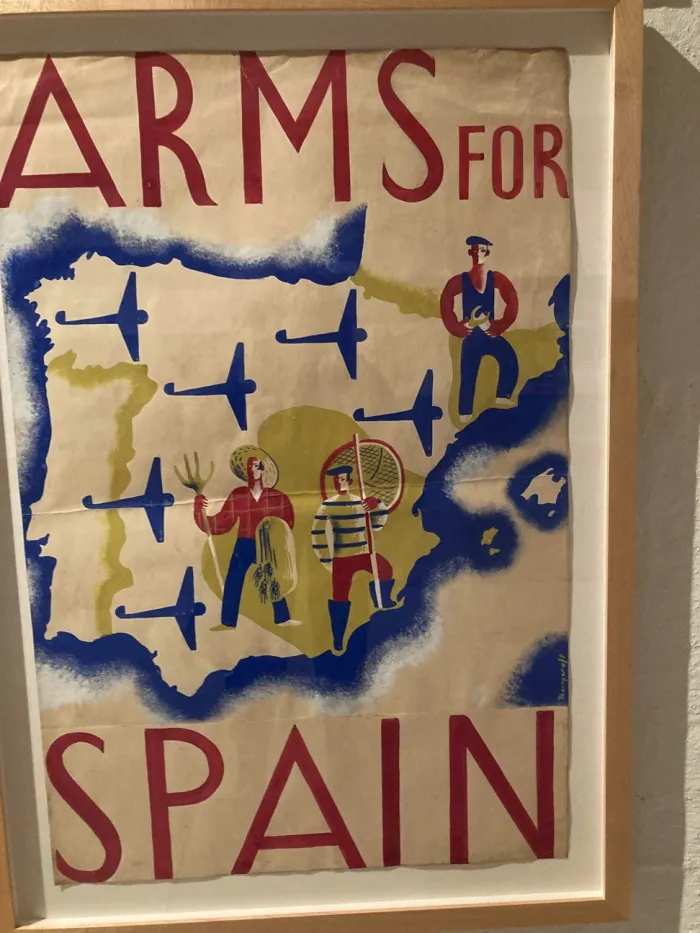
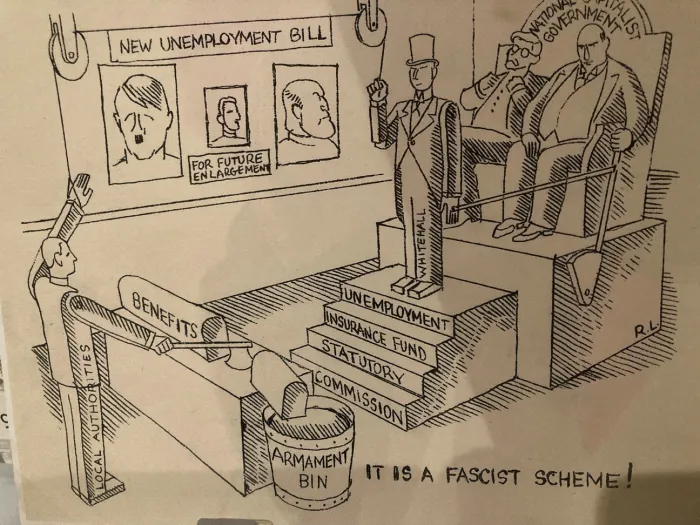
The Spanish Civil War and the art and visual propaganda it generated harnessed art to activism but the battle was already lost. Guernica’s tour and the AIA’s valiant project changed nothing. Britain declared war with Germany on 3 September 1939; Franco’s dictatorship lasted till his death in 1975. Guernica held no more power to affect events than the AIA’s propaganda banners and posters. Its greatest and enduring impact was on artists: from Max Ernst, Henry Moore, John Craxton, Merlyn Evan to Francis Bacon and Jackson Pollock.
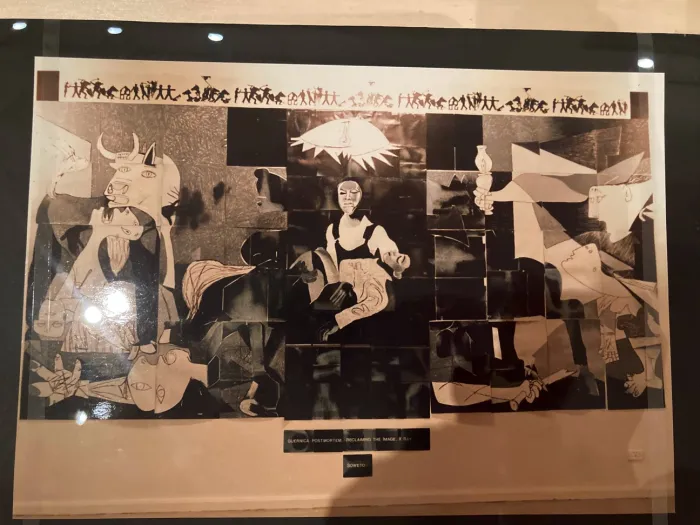
Most recently, the late British artist Donald Rodney’s 2025 exhibition at the Whitechapel included a photograph of his lost work Soweto/Guernica 1988, a collage of Picasso’s work and a photograph of the schoolboy, Hector Pieterson, murdered by the South African authorities.
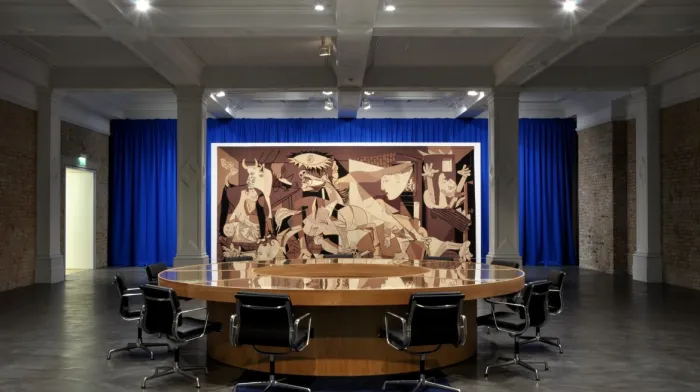
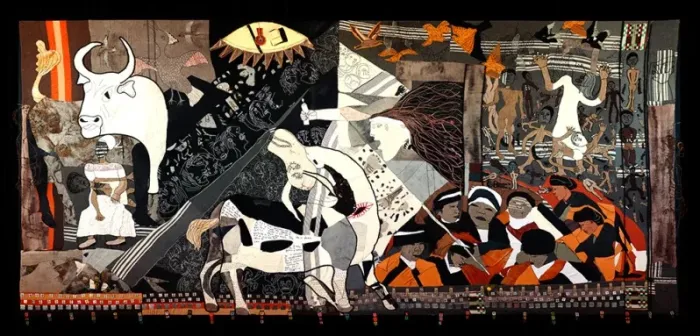
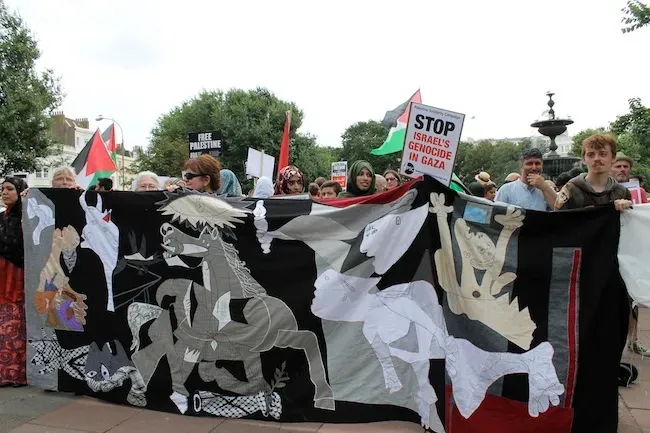
Guernica’s unique contemporary status as an anti-war icon was built by its subsequent tour and canonisation in the United States. Like Shostakovich’s Leningrad Symphony and Britten’s War Requiem, Guernica’s latent power is generative. The seminal project of artist Goshka Macuga, The Nature of the Beast, at the Whitechapel Art Gallery in 2009 focused on Guernica’s recent political history and co-option by artist collectives and activists worldwide. The work centred on the tapestry of Guernica from the Rockefeller Foundation which has hung since 1985 outside the Security Council Chamber in the UN building in New York. In 2003, when US Secretary of State Colin Powell signalled the invasion of Iraq, the US insisted it was covered with a blue cloth. The Guernica Remakings is collective protest project led by artist and designer Nicola Ashmore; its worldwide remakings include 2010 The Keiskamma Guernica, a tapestry made by village women in the Eastern Cape of South Africa.
Picasso was a lifelong pacifist. He lived through two World Wars, in France under German occupation, the Holocaust, the Soviet crushing of Hungary and the Prague Spring, the Cuban missile crisis, the collapse of colonial powers, but he did not become a committed political artist. He argued that an artist is responsive to the world and as such is a political being and that ‘painting is not done to decorate apartments. It’s an instrument of war for attack and defence against the enemy’. But it could not be prescribed. In 1932 he was unequivocal: ‘I will never make art with the preconceived idea of serving the interests of the political, religious or military art of any country. I will never fit with the followers of the prophets of Nietzsche’s superman’. His work is veiled with metaphor and freighted with sometimes obscure visual references which are not easily read. As his biographer John Richardson said, until the 1930s the nearest he got to any overt political gesture was a red circle he painted on the title page of Stravinsky’s The Volga Boat Song in 1917. While the maelstrom of horror which gathered in Europe, especially in his homeland Spain, affected him profoundly, he was reluctant to align, he did not join the French Communist Party until 1944, only too aware of internecine factions and threats to individual freedoms, not least his. In the Peace Movement he thought he was among brothers, but he was valued for his celebrity and one drawing, his ubiquitous peace dove, not for his life’s work. John Berger even went so far as to suggest that he should have left Europe, that his roots and his work were cross cultural and that he could have ‘become the artist of the emerging world, challenging the hegemony of Europe’. But Picasso never really left Spain. He attempted unsuccessfully to negotiate with the Franco regime to try to get his work shown in the Prado, Madrid, alongside his revered Velasquez and Goya. His unwavering core commitment was to his art and to protect his work and his legacy. He would have agreed with Aldous Huxley, writing for the AIA’s ‘Artist Against Fascism’ exhibition 1935: ‘the whole activity of the self-disciplined artist is a standing protest against war and dictatorship’.
Postscript
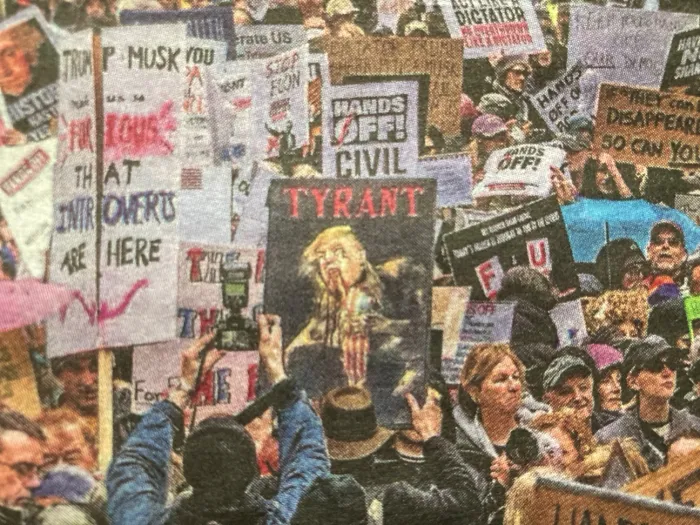
A placard at an anti-Trump demonstration in Los Angeles published in The Times on 7 April 2025 cannibalised Goya’s terrifying black painting Saturn devouring his son, showing Trump as Saturn - and Tyrant. He had earlier made one of his bizarre utterances: ‘Republicans Eat Their Young’. It is not hard to see political parallels with the 1930s. In a celebrity and market driven contemporary art world, there is little other sign of the brave militant solidarity among artists which inspired the Artists International Association.